Sidewalk Delivery Robot Insurance Requirements by City
Cities impose wildly different insurance requirements on sidewalk robot operators.

Sidewalk delivery robots sit in a gap, because neither federal vehicle law nor standard commercial insurance was built to fill it. A federal traffic safety regulator has declined to issue comprehensive rules for low-speed delivery robots, choosing instead to leave regulation to states and cities. There is no single national standard an operator can point to and say: this is the baseline. Because these machines travel on sidewalks rather than roads, they generally don't need auto insurance. Instead, operators fall back on product liability or general liability frameworks, both of which were built for defects you can trace and inspect: a faulty brake line, a mislabeled warning, a part that failed in a way an engineer can reconstruct after the fact. A sidewalk robot's navigation decisions come from a probabilistic model, and when that model picks the wrong path around a pedestrian, there's often no single defect to point to, just a judgment the system made in the moment.
That structural mismatch compounds when something actually goes wrong. One incident involving a sidewalk robot can produce simultaneous claims against the hardware manufacturer, the software developer that built the navigation model, and the company operating the fleet on city sidewalks. A standard policy drafted around one of those parties rarely addresses all three clearly, and the gaps between them are exactly where claims get denied or delayed for lack of a party willing to pay for them. A petition filed in Chicago documents more than 350 resident incident reports, including at least one injury that required stitches. These are claims already working their way through active pilot programs, in cities where the insurance architecture to handle them is still being worked out.
The State-Versus-Local Authority Divide
The question of who regulates sidewalk robots, the state or the city, sets the entire shape of what insurance an operator has to carry. Two models dominate. States like Arizona and Florida have preempted local regulation entirely, which means an operator deploying there works from a single statewide framework and never has to negotiate permit terms city by city. States like California take the opposite approach, so local governments stay free to add their own restrictions or ban robots outright within their borders.
The practical effect of the local-authority model appears the moment an operator crosses a city line. A robot fleet can move from a permissive town into a neighboring city with a moratorium or a restrictive permit scheme, with no change whatsoever in the underlying state law. Knoxville illustrates how sharply this can cut. The city council voted unanimously to prohibit personal delivery devices within city limits, which confines robot operations to the University of Tennessee campus, a parcel of state property exempt from the city's right-of-way ordinance even though it sits inside city limits. The state framework around Knoxville stayed permissive the entire time; the restriction came entirely from the city.
Virginia shows a middle path between full preemption and open local authority. Cities there cannot ban personal delivery devices outright, but they can prohibit them on specific sidewalks or at specific crosswalks by ordinance, so local authority survives in a narrower form. The insurance consequence of all this follows directly from which model an operator is working under. In a preempted state, the operator identifies the statewide insurance floor once and builds a coverage structure around it. In a local-authority state, that same operator has to audit the permit conditions of every city it wants to operate in, because each of those permits can carry its own, separate insurance mandate layered on top of the state's.
State-Level Insurance Floors
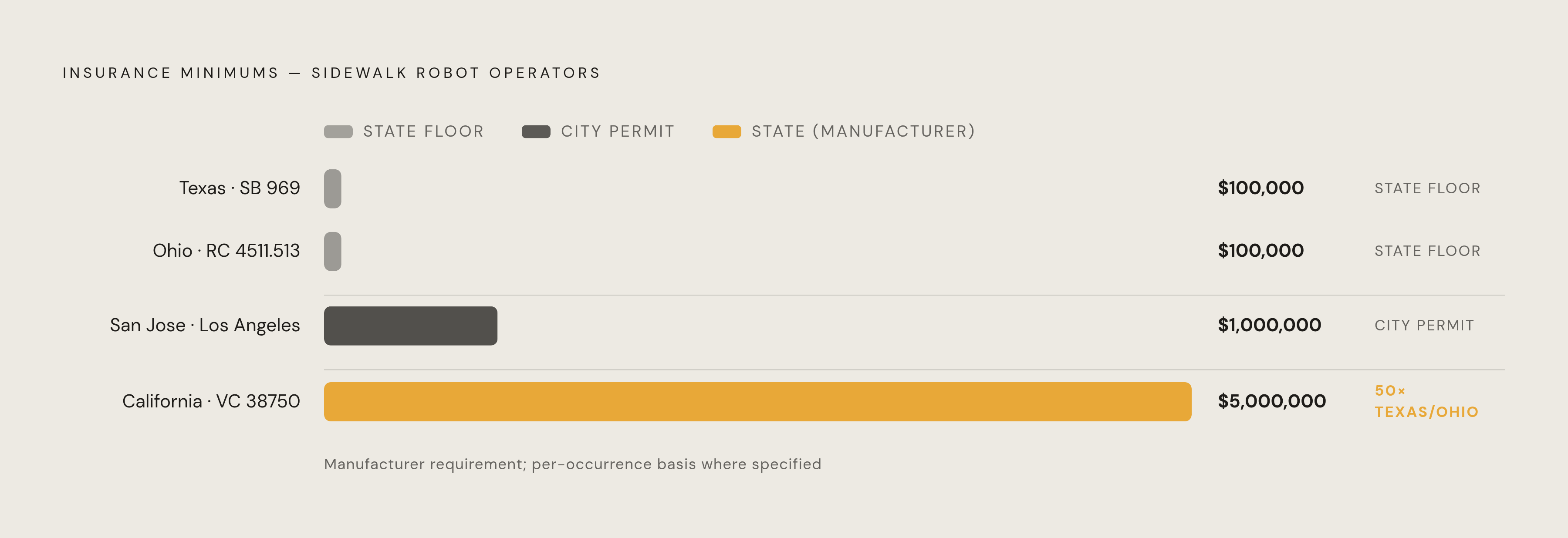
State insurance minimums exist, but they set a floor far below what an enterprise customer, a city permitting office, or the real cost of an incident is likely to demand. As of 2026, the figures vary widely by state. Texas requires a business entity operating a personal delivery device to carry general liability coverage of at least $100,000 for damages arising from the device's operation, under SB 969. Ohio sets the same $100,000 minimum under Revised Code section 4511.513. California's framework works differently: state law under Vehicle Code section 38750 requires manufacturers to carry $5 million in insurance, a surety bond, or proof of self-insurance, a considerably higher bar than Texas or Ohio; the commonly cited $1,000,000 figure in California actually comes from a local permit, the City of Los Angeles's LADOT personal delivery device permit. Virginia, by contrast, specifies no state minimum.
Even where guidance exists, it can lag behind what operators actually need on the ground. A state transportation agency published a white paper summarizing proposed legislation that would require a liability insurance baseline for sidewalk robots, but the paper stops short of recommending any specific dollar figure. Official guidance, in other words, can arrive without the one number an operator most needs to plan around.
The clearest illustration of the gap between a state floor and what a real deployment requires comes from San Jose. Operating under California's local-authority framework, San Jose's Department of Public Works requires $1,000,000 per occurrence for bodily injury, personal injury, and property damage under its standard Encroachment Permit, the same figure as the commonly cited California baseline. An operator who assumes "we carry the state minimum, so we're covered" runs into trouble the moment it enters a city that layers its own permit conditions on top of that floor, and the next section shows that in local-authority states, that layering is standard practice.
City permit conditions that exceed state floors: San Francisco, Washington D.C., Minneapolis, and Boston
Four cities show how far permit conditions can diverge from state floors, and how directly those conditions translate into insurance obligations a standard policy may not meet.
Under Section 794, San Francisco's Public Works ordinance sets a 3 mph speed limit and requires a human operator to stay within 30 feet of the robot at all times. Section 794(h)(2) further requires each permit holder to report data, business information, and incidents, including public complaints, to the City Administrator's Office and Public Works on a monthly basis (this reporting obligation sits outside SFMTA's jurisdiction entirely). For an operator, that monthly disclosure requirement is itself a source of exposure: a reported incident becomes a matter of public record, and a pattern of complaints visible in monthly filings can support a liability claim long before any lawsuit is filed. Coverage built only around the physical act of a robot striking a pedestrian misses the liability that monthly compliance reporting can generate on its own.
A city transportation department's program restricts robots to a weight limit excluding cargo, a speed cap under 10 mph, and operation only on sidewalks, crosswalks, and alleyways, with alleyways explicitly included among the permitted zones. Robots must also remain visible from at least 300 feet at all times. D.C. Code section 50-1555(a) adds a geographic restriction on top of these operating limits: a registered device that meets the conditions of subsection (b) may operate on sidewalks and crosswalks anywhere in the District except within the Central Business District, unless the operator satisfies additional conditions. An operator seeking to serve downtown D.C. is negotiating a materially different, and likely more demanding, set of terms than one operating only in the city's outer neighborhoods, and insurance terms calibrated to the outer zones won't necessarily extend to a Central Business District expansion.
Minneapolis ran its sidewalk robot program as a one-year pilot, from September 1, 2024 through August 31, 2025, under an authorization the city council's own legislative record describes in exactly those terms. Because the permit itself was time-limited, any operator seeking to continue in Minneapolis faces a fresh negotiation for renewal, and that renewal can arrive with updated insurance conditions that look nothing like the terms under which the operator first deployed.
Boston's 2025 guidelines follow a similar logic: a capped, evidence-based pilot structure, where terms are tied to the pilot's current scope and can be renegotiated as that scope expands. If a pilot grows past its early, limited phase, you should not assume the insurance terms agreed to at the start will carry over unchanged.
Across all four cities, the common thread is the same. Each requires indemnification and lists itself as an additional insured on the operator's policy. Each imposes operational restrictions, on speed, weight, hours, or geography, whose violation creates a separate and independent source of liability beyond any physical incident. And in each case, these are conditions that a standard commercial general liability form, drafted before autonomous sidewalk operations existed as a category, is unlikely to address without specific modification.
Why standard commercial general liability policies are structurally inadequate for sidewalk robot operations after January 2026
An operator who believes a standard commercial general liability policy satisfies these permit conditions may be carrying coverage that excludes the very losses a robot incident is most likely to produce. In January 2026, the Insurance Services Office introduced standardized exclusions for claims involving generative AI, filed as three endorsements: CG 40 47, CG 40 48, and CG 35 08. The third of these, CG 35 08, extends the exclusion specifically into the Products and Completed Operations Coverage Part of the policy, the section that would otherwise respond to a claim that a robot's product design or performance caused harm after it left the manufacturer's hands.
The mechanism is direct. A pedestrian struck by a robot whose navigation system made the decision that led to the collision may find that the operator's CGL policy excludes the claim under one of these AI endorsements, because the harm traces back to an AI-driven decision. That is close to the pattern already documented in Chicago's incident reports. Carrying general liability insurance, paying the premium, and having a policy on file no longer guarantees a claim gets paid: the permit condition can look satisfied on paper while the claim itself is excluded at the one moment it actually matters.
Andrew Hill, WTW's Global Head of Cyber Coverage and Innovation (FINEX), described the resulting exposure directly: "Robot malfunctions can give rise to a combination of cyber, bodily injury, property damage, professional liability and product liability exposures." He added: "Because many policy wordings were drafted before the widespread adoption of AI and autonomous systems, there is a real possibility that coverage gaps or grey areas emerge between policies." Those gaps sit exactly at the intersection a sidewalk robot occupies: a physical machine, controlled by software, operating in public space under a permit that names the city as an additional insured.
The full coverage stack a sidewalk robot operator needs, line by line
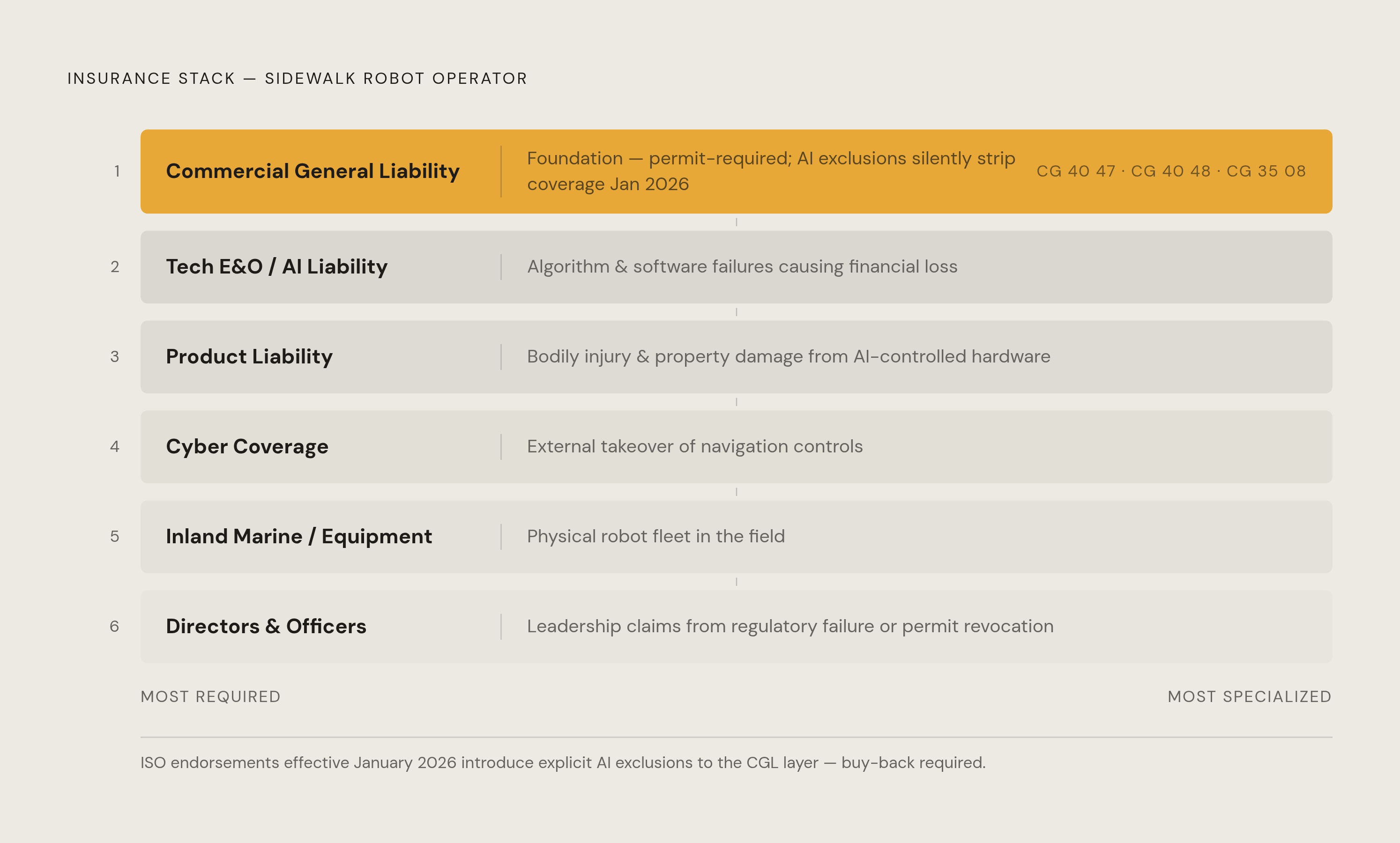
Closing the gaps identified above takes a coordinated set of coverage lines working together, not one policy stretched to cover everything.
Commercial general liability remains necessary. Most permits, leases, and commercial contracts require it as a baseline. But given the January 2026 ISO exclusions, the CGL policy has to be structured to affirmatively buy back AI-related coverage and to name the relevant municipality as an additional insured wherever a city permit requires it. A standard, unmodified CGL form should not be assumed to do either.
Tech errors and omissions coverage, sometimes written as AI liability, protects against claims that a machine learning model, an algorithm, or a software deployment failed to perform as promised and caused financial loss as a result. This line matters because many of the permit violations described in the city section above (exceeding a speed cap, operating outside an approved zone, missing a reporting deadline) generate professional liability claims rather than bodily injury claims, and a CGL policy alone typically won't respond to that category of loss.
Product liability covers bodily injury and property damage that arise from a physical product, including AI-powered devices. When an AI system controls a physical object like a delivery robot, product liability is the line that responds to the physical harm that results. It does not extend to purely digital failures that cause only financial loss without a physical injury or damage component attached.
Cyber coverage addresses a scenario distinct from an AI misjudgment: an outside attacker taking over a robot's navigation controls. This is a coverage gap identified directly in current research on the risk, because standard cyber policies often exclude bodily harm caused by a software malfunction. The overlap between cyber, CGL, and product liability has to be worked out explicitly in the policy language; none of the three can be assumed to pick up the slack left by the others.
Inland marine, or equipment coverage, protects the physical robot fleet itself against loss, theft, or damage while in transit or out in the field. Robots are mobile property operating away from any fixed premises, which is the exact situation inland marine coverage was built to address, and which a standard property policy, built around a fixed location, typically excludes.
Directors and officers coverage rounds out the stack. Investors typically require D&O coverage as a condition of closing a funding round. For an operator scaling into multiple cities, each with its own permit terms, regulatory compliance failures and the revocation of a city permit can generate claims against the company's leadership directly, separate from any claim tied to a specific robot incident.
How submission quality determines whether a specialist policy covers what a permit requires
Even a well-structured coverage stack depends on the accuracy of what an operator discloses when applying for it. A specialist underwriter pricing AI liability or product liability for a sidewalk robot fleet is pricing the specific behavior of that fleet: how the navigation model was trained, what sidewalk and crosswalk restrictions it operates under in each city, what speed and weight limits apply, and what the monthly incident reports to a city's permitting office actually show. An application that describes the robot fleet in generic terms, without tying its disclosures to the specific permit conditions in San Francisco, Washington D.C., Minneapolis, or Boston, invites the underwriter to price the policy against a generic risk.
That gap between a generic submission and the operator's real regulatory footprint is where a policy can look complete at binding and still leave a claim exposed later. If a submission documents the exact speed limits, weight limits, and operating zones an operator has agreed to under each city's permit, an underwriter can confirm the policy responds to those specific conditions, including the AI-related exclusions introduced in January 2026. Given how differently Arizona, Florida, California, Virginia, and the cities operating under local authority all treat these machines, the insurance an operator ends up with is only as sound as the jurisdictional detail that went into building it.