Commercial Auto vs. AV-Specific Policy Forms
Standard forms collapse at Level 4 because they were built to judge drivers, not software.
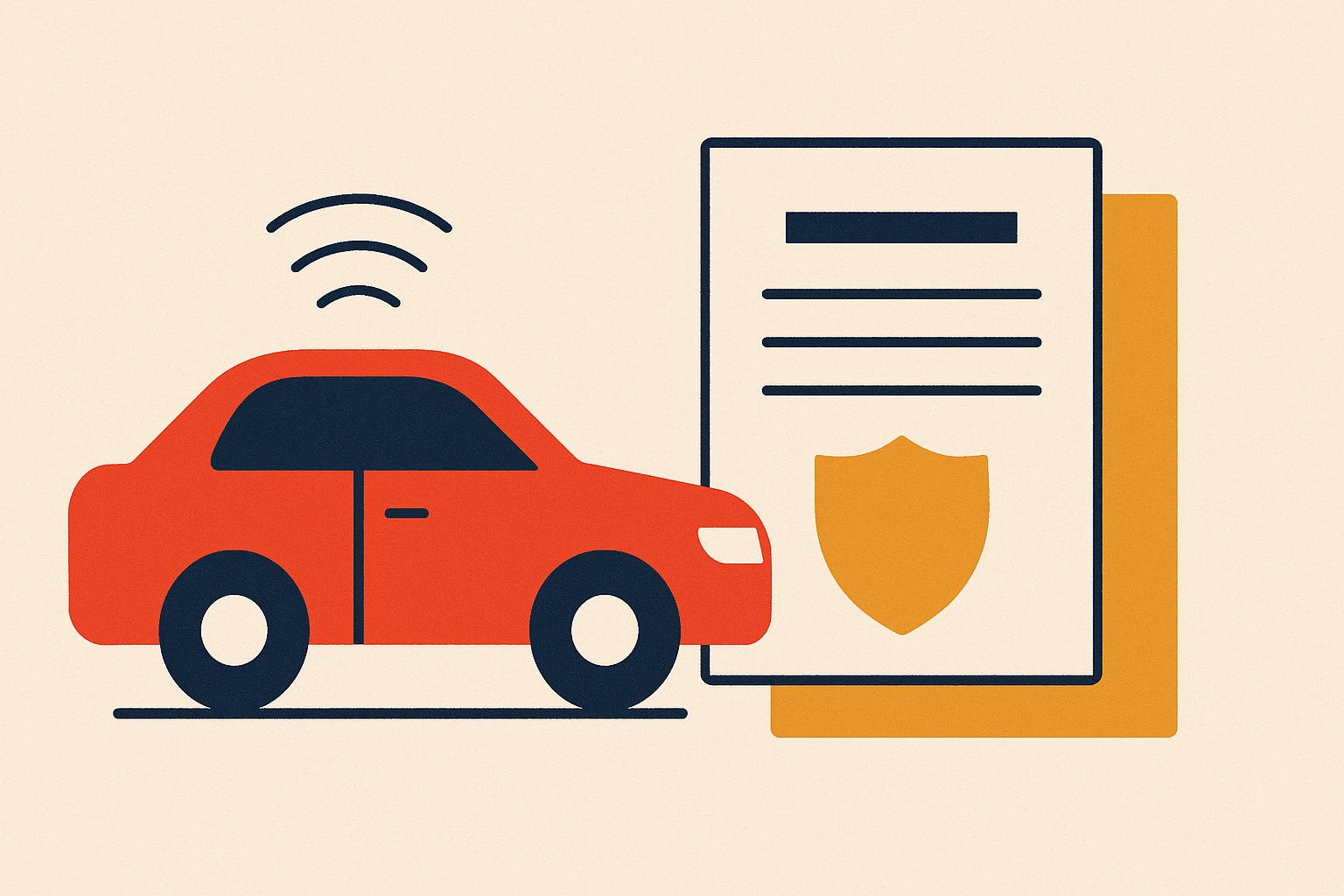
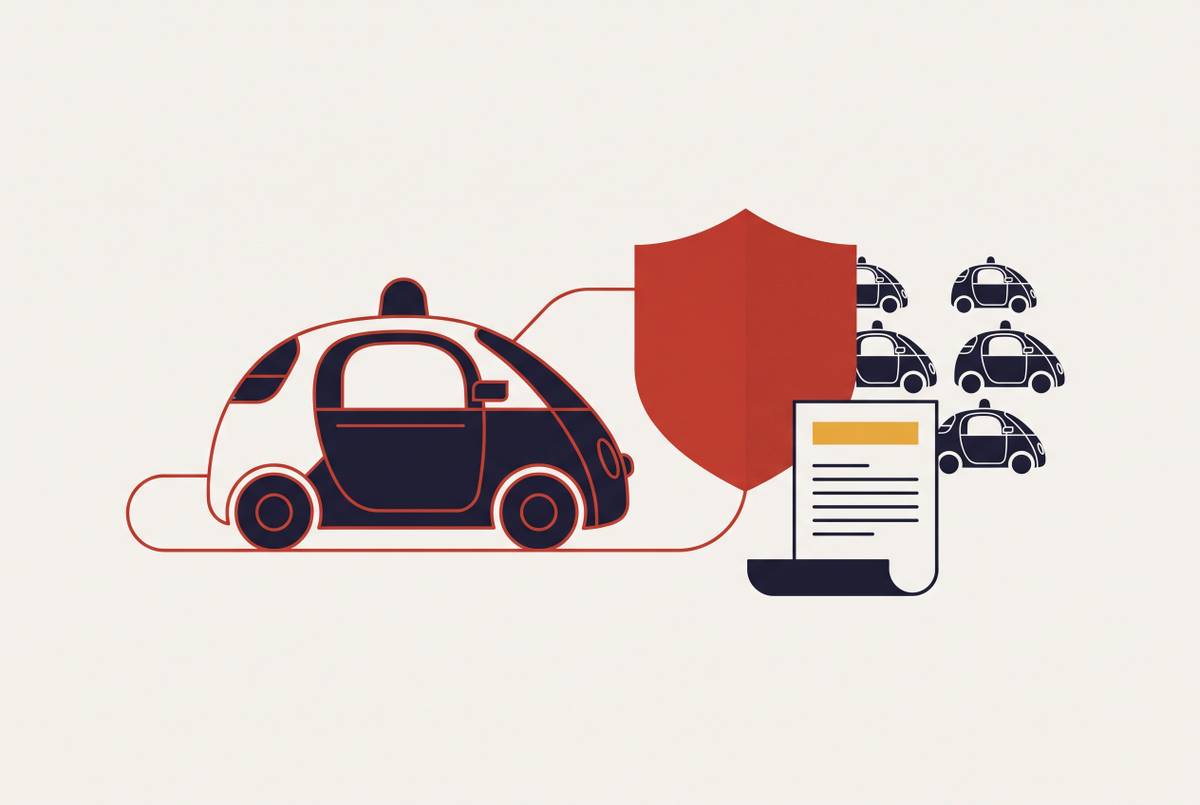
A commercial auto policy, at its core, insures a decision made by a person behind the wheel. Every part of the form, how fault gets assigned, who counts as an insured, what event triggers a payout, assumes that a driver exists and that the loss traces back to something that driver did or failed to do. At SAE Level 2 and Level 3, automation handles parts of the driving task, but a human stays legally responsible for the vehicle, so that assumption still holds. The person retains residual liability even when the car is doing some of the work, so the standard form can keep functioning without much strain. Level 4 removes the person from the control loop entirely, and once there is no driver act to point to, the form has no act to insure. A policy built to judge human behavior has nothing left to judge once the behavior that caused the loss belongs to software.
The specific clauses in standard commercial auto forms that fail at Level 4 and above
Once a vehicle operates without anyone in the driver's seat, specific clauses in the standard form stop working, not as abstractions but as individual pieces of language that either pay out wrong, pay out nothing, or exclude the loss. The "who is an insured" section defines coverage around a named insured and permissive users, categories built for people who hold a license and get behind a wheel. A software stack does not fit into either slot, so a claim involving an autonomous system can run into a definitional wall before anyone even gets to the question of fault. Fault-attribution language runs into a similar problem: standard forms expect an adjuster to identify negligent driving behavior, but when the "driver" is an algorithm, proving fault means getting into proprietary system logs that the form has no mechanism for requesting, reviewing, or even acknowledging. A well-known autonomous driving system illustrates the dynamic directly. If FSD is at fault in a crash, accepting that liability depends on data that only Tesla holds, and standard commercial auto forms were never written with that kind of evidentiary dependency in mind. Product liability would respond when a software or design defect causes the crash in the first place, but that coverage does not even sit inside a commercial auto form. It lives in a separate policy family that most operators never think to pair with their auto coverage until a claim exposes the gap. Standard forms also carry absolute cyber exclusions, a structural weak point, because an autonomous vehicle is, functionally, a networked computer that happens to move.
The liability-attribution problem when no party is clearly at fault
Every clause failure described above gets worse the moment more than one party touches the incident, and that is almost always the case with AV losses. A single crash can implicate the OEM that designed the hardware, the developer that wrote the automated driving system, the fleet operator that made the deployment decisions, and the platform that handled dispatch and routing, all at once. Standard commercial auto forms were built to insure one named insured and assign fault to one driver, so they have no built-in way to divide a loss across four parties who each contributed something different to the outcome. Strict product liability, the legal doctrine that holds a manufacturer responsible for a defect regardless of whether anyone can prove negligence, is widely viewed as the doctrine most likely to govern Level 4 incidents, and that doctrine belongs to products coverage, not auto coverage. Regulation does nothing to simplify this. One foreign regulator has already put mandatory liability coverage requirements in place for Level 4 vehicles, so it is one of the first to build anything close to a full AV insurance framework, while the domestic market still has no equivalent requirement. Compare that to the patchwork a U.S. operator actually faces: one state permits damage awards that run far higher than another allows, while a third state treats AV liability no differently than any conventional vehicle on its roads. A company running vehicles across all three states cannot answer the liability-attribution question with one standard commercial auto form, because each state is effectively asking a different question.
What a purpose-built AV policy form does structurally differently
A purpose-built AV policy form does not patch the standard form; it replaces the logic underneath it. Where a commercial auto policy names a driver as the insured and attaches liability to driving acts, an AV-specific form names the system operator or the manufacturer and attaches liability to how the system performs. That is an architectural change, not a broader version of the same instrument. Carriers working in this space have largely stopped trying to stretch standard ISO auto forms to cover autonomy, moving instead toward manuscript-style policies, custom-drafted instruments that blend auto liability, product liability, and technology errors and omissions coverage into one document. Pricing follows the same logic shift. Apollo's ibott division prices risk per mile, per delivery, or per trip instead of using conventional motor insurance rating factors built around a driver's history, because the thing generating the risk is system usage, not a person's driving record. The same architecture lets a form explicitly cover product liability when an AI-controlled system causes a loss, so it closes the gap that standard auto forms leave open between auto and products coverage. Cyber coverage gets built in from the start rather than bolted on, and that matters because standard general liability and auto forms carry absolute cyber exclusions, even though an autonomous vehicle is a networked system that can be attacked like any other.
What purpose-built AV programs look like in practice
These architectural ideas are not theoretical. Several programs already operate on exactly this system-centric model. In March 2026, Marsh Risk and Apollo launched a dedicated insurance facility for autonomous vehicles running on Uber Technologies' global ride-hailing and delivery platform, wrapping developers, fleet operators, and vehicle manufacturers into a single master policy instead of leaving each party to arrange separate standard coverage that may or may not line up. The program sits inside Uber Autonomous Solutions and is meant to help partners commercialize and scale driverless ride-hailing and delivery across multiple jurisdictions at once, which only works if the underlying coverage can follow the operation across those jurisdictions and stay intact at every state line. Axis Insurance has built a program specifically for companies that make and deploy autonomous robots, and it gives AV hardware companies, whose risk looks less like a car crash and more like a perception failure or a software fault, a useful reference point. The Axis program covers bodily injury and property damage caused by AI navigation or perception failures, and it also covers production losses when a software update or sensor failure takes a robot offline even if nothing physically breaks, a category of loss that standard commercial auto and general liability forms simply do not reach. Relm Insurance launched a program with PONTAAI in January 2025, another entry in the same category of purpose-built autonomy coverage. On the consumer side, Lemonade launched an autonomous car insurance product in January 2026 that connects directly to Tesla's Fleet API to separate FSD-engaged miles from human-driven miles, a clean illustration of what exposure-based pricing looks like once it is fully built out: the rate follows what the system is doing.
Coverage lines that AV-specific forms integrate and that standard commercial auto forms leave out entirely
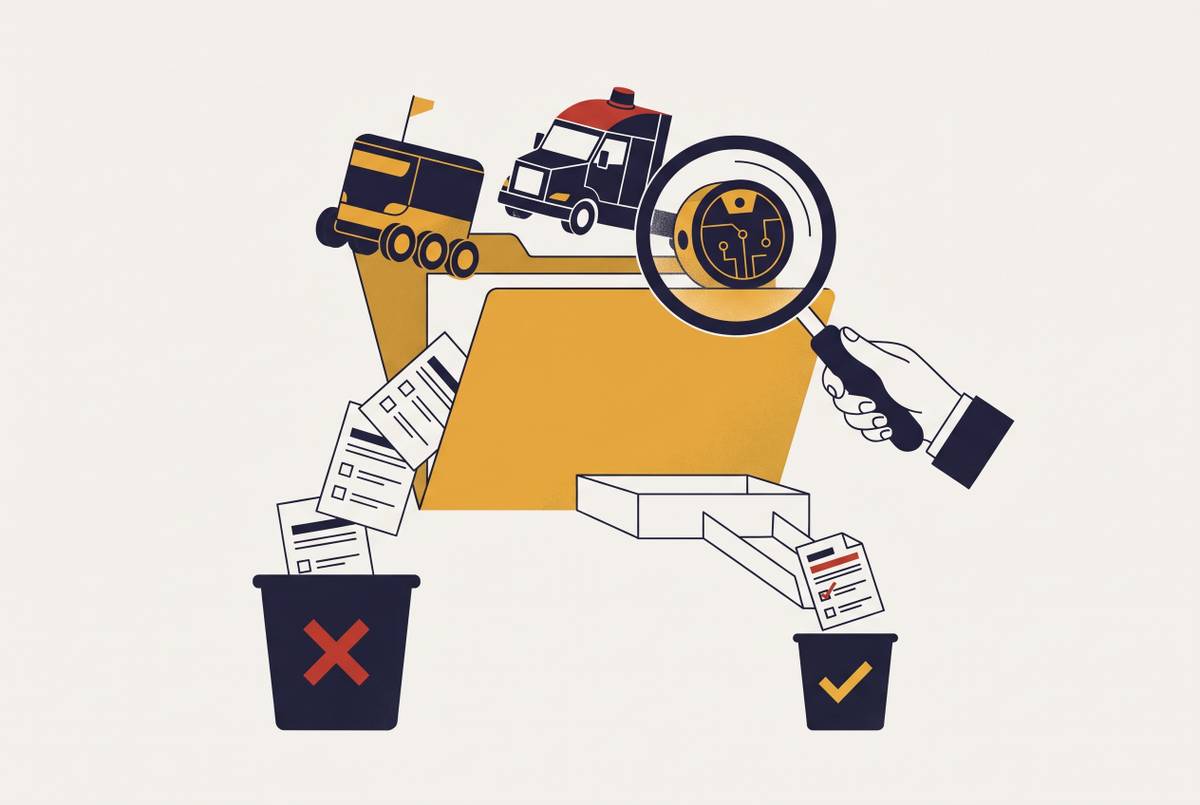
The gap between a standard commercial auto form and what an AV operation actually needs is several coverage lines that belong to different policy families, not one missing endorsement. Tech errors and omissions coverage, paired with product liability, becomes necessary the moment AI controls a physical system, and that coverage has to be written to respond to algorithmic failure, not just the traditional manufacturing defect a products policy was originally built around. Cyber coverage matters for the same reason: an autonomous vehicle is a networked platform, and standard auto forms explicitly exclude a cyberattack that takes over its controls. The Axis program shows how that gap gets closed in practice, folding cyber coverage directly into the policy so that physical damage and control-loss events caused by an attack are addressed as part of the same instrument rather than left for a separate cyber policy to maybe pick up. Business interruption coverage for non-physical loss fills a third gap. Standard commercial auto and general liability forms respond only to physical damage. A robot or AV that goes offline because of a software failure, with no dent, no injury, nothing physically broken, produces a production loss that the standard form has no clause to pay. A software-triggered stoppage hits hardest for AV operators running commercial fleets or logistics operations, appearing immediately on the balance sheet even though nothing was damaged. The gap is also widening. Starting in late 2025, major U.S. carriers began filing sweeping AI exclusions into standard errors and omissions, directors and officers, and commercial general liability forms, often buried inside endorsement language a policyholder would need to go looking for. Verisk's ISO Form CG 40 47 01 26, effective January 2026, specifically lets carriers exclude generative AI claims from commercial general liability policies. The standard policy stack that a generic broker hands to an AV company is not just failing to cover autonomy, it is actively narrowing around the exact risk profile that AV and AI hardware companies carry. Identifying which clauses will respond and which won't requires reading the actual policy language against AV-specific underwriting criteria, a step most general brokers skip. Risklytics, a licensed commercial insurance broker built specifically for autonomous systems companies, works directly with carriers that have developed AV-specific underwriting, and it maps exactly where standard commercial auto language breaks down, so a client's submission reflects the real structure of their operation.
The federal regulatory vacuum that keeps standard forms in place
Standard forms stay in circulation for AV operators because nothing in the regulatory or data environment is forcing a change, even though carriers are aware of the mismatch. AV regulation in the U.S. remains a patchwork of state-by-state rules on permitting, safety reporting, data standards, and commercial operation requirements, with no unified federal framework tying them together. Without standardized data reporting requirements, OEMs keep control of vehicle logs and system performance data, so underwriters have no consistent basis for pricing AV risk on its own merits and default back to the familiar commercial auto form. Fitch Ratings, looking ahead from early 2026, projects no meaningful impact on insurers from AV adoption for at least another decade, so the broader insurance market has little commercial reason to rush new form language into the field. The practical effect falls on the operator: a company that accepts a standard commercial auto policy because it is the thing on offer is accepting a form that was never built for its risk, and neither the regulatory environment nor the market is under any pressure to fix that on the operator's behalf.
Options for AV operators and AV hardware companies when a generic broker offers only standard forms
An AV operator handed a standard commercial auto policy by a generic broker should treat that policy as the start of a coverage audit rather than a finished answer, because the gap sitting in that form came from the broker's library, not from anything the operator did wrong. Four questions make that audit concrete. Does the policy respond to a loss caused by an algorithmic failure, or does it respond only to a loss caused by a driving act in the traditional sense? Does the policy include cyber coverage outright, or does it carry an absolute cyber exclusion, and has that language been checked against the AI exclusion endorsements carriers began adding in late 2025? Does the policy cover a production loss when an AV or a robot goes offline with no physical damage at all, or does it only respond once something is actually broken? A standard commercial auto form will fail all four of these questions for any Level 4 or above operation. Specialist carriers who explicitly underwrite autonomy, and manuscript-style forms that blend auto liability, product liability, and tech errors and omissions into one instrument, are the right place to start looking instead. The fragmentation across state regulation adds another layer to this problem: a company running AVs in multiple states cannot resolve the liability question with a single application, because each state's framework calls for a different underwriting approach. A specialist broker focused on frontier hardware deployment, among them Risklytics, manages that multi-state structure by building submissions that separate OEM liability, software liability, and fleet operator liability from the outset, so the placement itself reflects how risk is actually distributed across the parties involved rather than forcing all of them into one driver-shaped form. The four questions above are the exact ground a specialist broker is built to answer, and they are the ground a generic broker, working from a standard commercial auto form, has no way to cover.