AV Fleet Insurance Requirements in Robotaxi Contracts
How robotaxi operators must layer coverage to meet contracts.
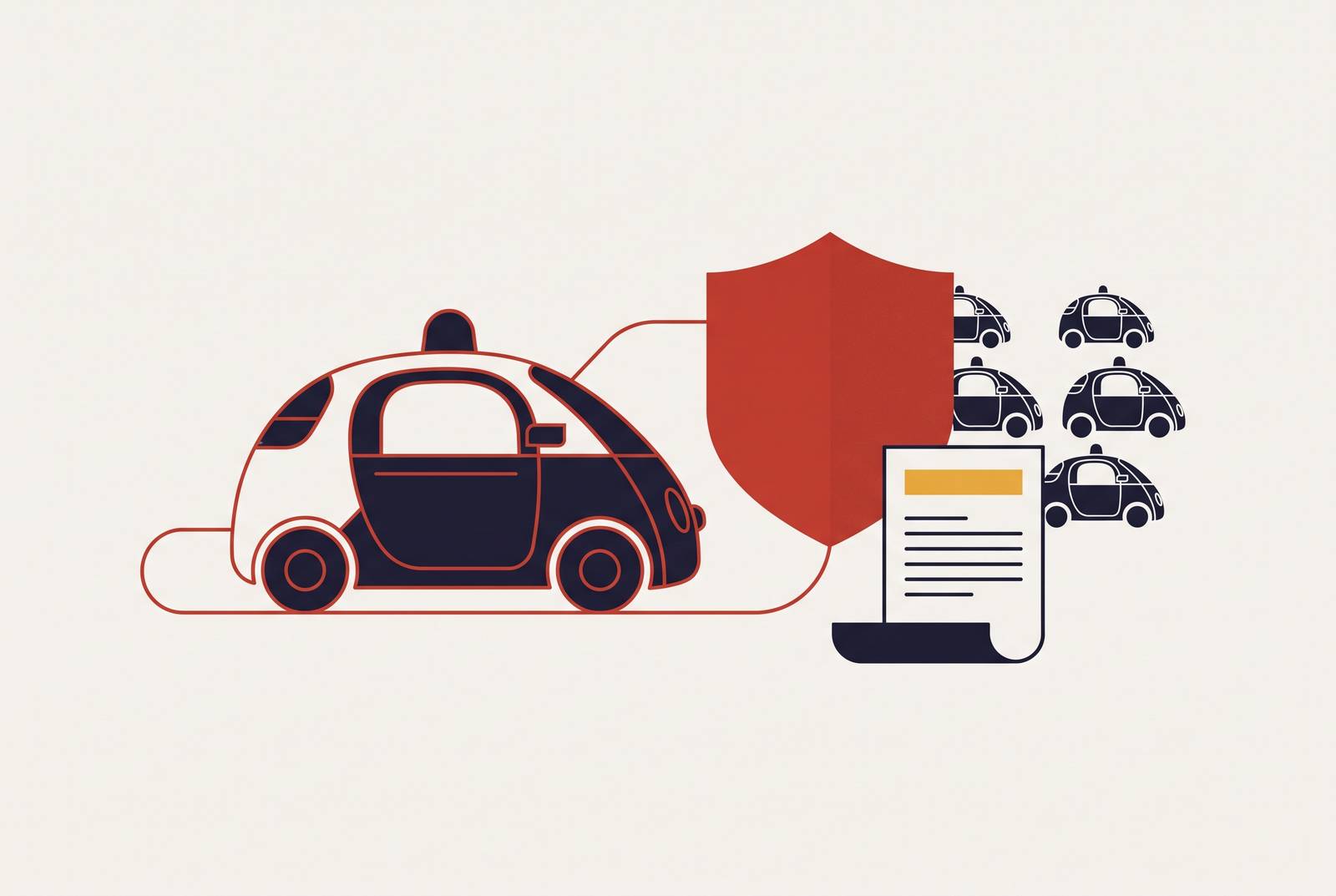
Robotaxi contracts require an insurance program built around autonomous operations. Underwriting submission quality for autonomous hardware depends on documenting the deployed software, operating boundaries, incident history, and governance controls. Operators must match that evidence to permit and contract requirements before binding coverage, or risk discovering the mismatch when a claim is denied.
Why standard commercial auto policies break down at L3 and above
Traditional auto insurance starts with a human driver. Its liability model rests on what that person does, with the vehicle as the means through which the loss occurs. Below L3, the system is still driver assistance, and human liability stays in place. At L3 and above, when the Operational Design Domain is met and the system is engaged, accident responsibility no longer automatically rests with the driver. The party that designed, updated, or deployed the autonomous driving software enters the liability picture.
This is a change in the insured exposure. A robotaxi is a mobile software product transporting paying passengers, so vehicle operation and product performance become intertwined. A collision may implicate the vehicle owner, fleet operator, autonomous driving system developer, hardware suppliers, and remote operators. Responsibility therefore requires more than an assessment of driving conduct. Sensor data and algorithmic decision logs become evidence for distinguishing a software failure from a hardware defect or an operational error, beyond the assumptions of a standard auto claims process.
Software updates make that exposure less stable over time. An over-the-air patch can change vehicle behavior overnight, so the version operating at the time of a collision becomes relevant to both underwriting and claims. Static models need to account for those changes to price the exposure accurately. Regulators and contracting parties have absorbed that logic into requirements that specify more than a conventional vehicle liability limit.
What regulators have already decided about minimum coverage for driverless passenger service
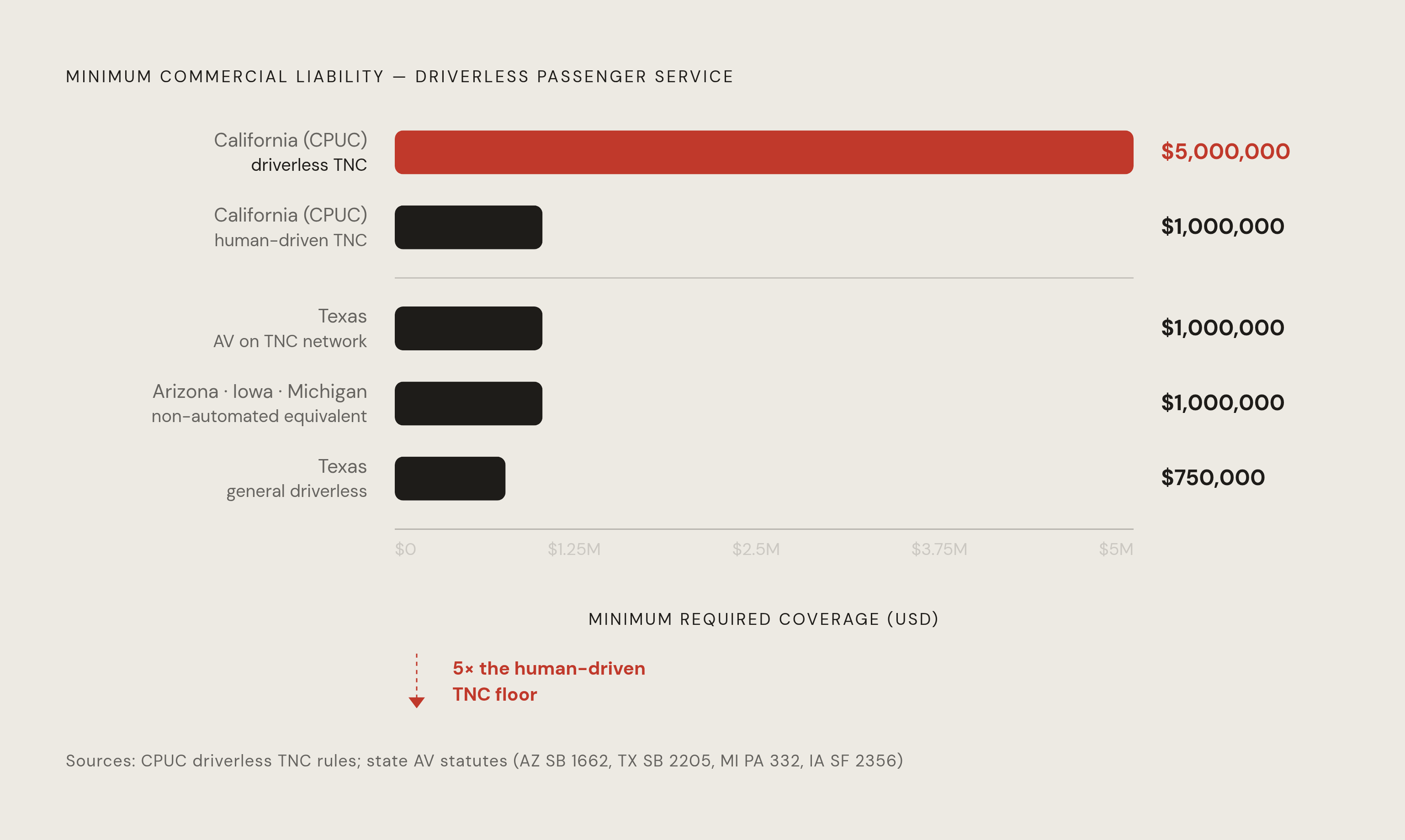
The CPUC requires autonomous rideshare operators providing driverless passenger service in California to hold a minimum of $5,000,000 in commercial liability coverage. That is five times the coverage required for human-driven rideshare vehicles. The requirement is meant to cover catastrophic losses that harm multiple victims when there is no human driver. It establishes a distinct insurance tier for autonomous service rather than treating it as an extension of the human-driven transportation network company framework.
The obligation exists before a commercial agreement is signed. An operator seeking to provide the covered service must account for it when designing the insurance program, rather than treating a customer’s contract as the starting point. A standard commercial auto placement does not, by itself, establish that the operator has met this autonomous-service requirement. The service category that applies and the limit it requires set the regulatory baseline.
Other states take a different approach to that baseline. Arizona, Iowa, and Michigan apply the same insurance requirements as those for non-automated vehicles. Texas does so for general driverless operation but imposes higher TNC/rideshare minimums when an automated vehicle operates on a ride network. The distinction turns on the service being provided. An operator expanding city by city therefore accumulates obligations tied to both jurisdiction and use, with the most demanding jurisdiction setting the minimum needed for a shared program intended to satisfy the full footprint.
NHTSA mandates crash reporting, while the California DMV mandates disengagement reporting under its testing program. Those records become underwriting data, giving insurers evidence about the system’s operating history. Operators with clean, documented records have a basis for presenting their risk. Operators without that record face pricing uncertainty because the insurer has less evidence on which to assess performance.
How operating agreements embed coverage demands that go beyond the regulatory floor
A network, fleet platform, enterprise customer, or facility may each face exposure from the same operation and require the operator’s insurance program to address it. Those demands remain enforceable even if the operator misunderstood them at signing. Contract terms set the extra limits, coverage lines, and endorsements that the commercial relationship needs.
A contractual limit can change the program’s architecture immediately. If an enterprise or government customer requires $5,000,000 in liability limits while the primary commercial auto policy provides less, a commercial umbrella is needed to close the gap. The trigger is the customer’s requirement. A permit-compliant placement can consequently remain insufficient for a particular agreement.
Garage-keeper coverage addresses a facility’s liability for damage to a customer’s vehicle left in its care, distinct from the vehicle’s own policy. A depot agreement will typically require that protection before onboarding vehicles. Remote operator arrangements introduce a different layer of responsibility. If a remote operator fails to respond or issues an unsafe override, secondary human negligence claims can arise, and the governing contract must specify which party’s insurance responds.
Evidence rights are another part of the insurance arrangement. Operating agreements increasingly require data reporting and preservation because claims investigation depends on access to sensor logs, LiDAR records, EDR telemetry, and remote operator communications. The obligation is not satisfied by having a liability policy alone. If the agreement does not establish access rights, the operator can lack the evidence needed to defend a claim or cooperate with its insurer.
Why the coverage stack for a commercial robotaxi operation is not reducible to a single policy
Commercial auto and umbrella form the vehicle-in-operation foundation. They address the liability limits associated with operating the fleet, but do not resolve its software, data, and product exposures. A compliant program instead coordinates coverage lines around the different ways the operation can cause or sustain a loss.
Technology errors and omissions addresses liability arising from the autonomous driving software. Design defects, algorithmic failures, perception errors, and inadequate updates can produce claims that do not fit conventional auto coverage. Product liability addresses a different source of failure. Sensor malfunctions, steering and braking linkage defects, and manufacturing flaws in the vehicle platform require a hardware-related coverage trigger rather than an assumption that software coverage will respond.
Cyber liability covers another way the operation can suffer a loss. Automotive cybersecurity incidents are a documented, growing exposure, and an attack that causes an accident or vehicle theft presents a scenario that neither commercial auto nor tech E&O is designed to cover. Cyber protection is therefore part of the operating program as well as protection for office systems. Its role follows directly from the vehicle’s dependence on software and data.
Inland marine covers high-value hardware away from a fixed facility, where standard commercial property coverage stops. The review of equipment coverage therefore needs to include depot storage, transit, and charging locations. This protection differs from garage-keeper coverage, which addresses the facility’s liability for a customer’s vehicle in its custody rather than the operator’s broader off-premises equipment exposure.
Policy labels alone do not settle any of these boundaries. Cyber carriers have begun adding affirmative AI coverage language, while general-liability and management-liability forms are starting to spell out exclusions. Even within a coordinated program, AI-related wording can change whether a particular loss receives a response. The distinction between the absence of an exclusion and affirmative coverage makes the actual wording of each policy central to the binding decision.
How do you get an insurer to understand your autonomous hardware company, and what makes a strong submission?
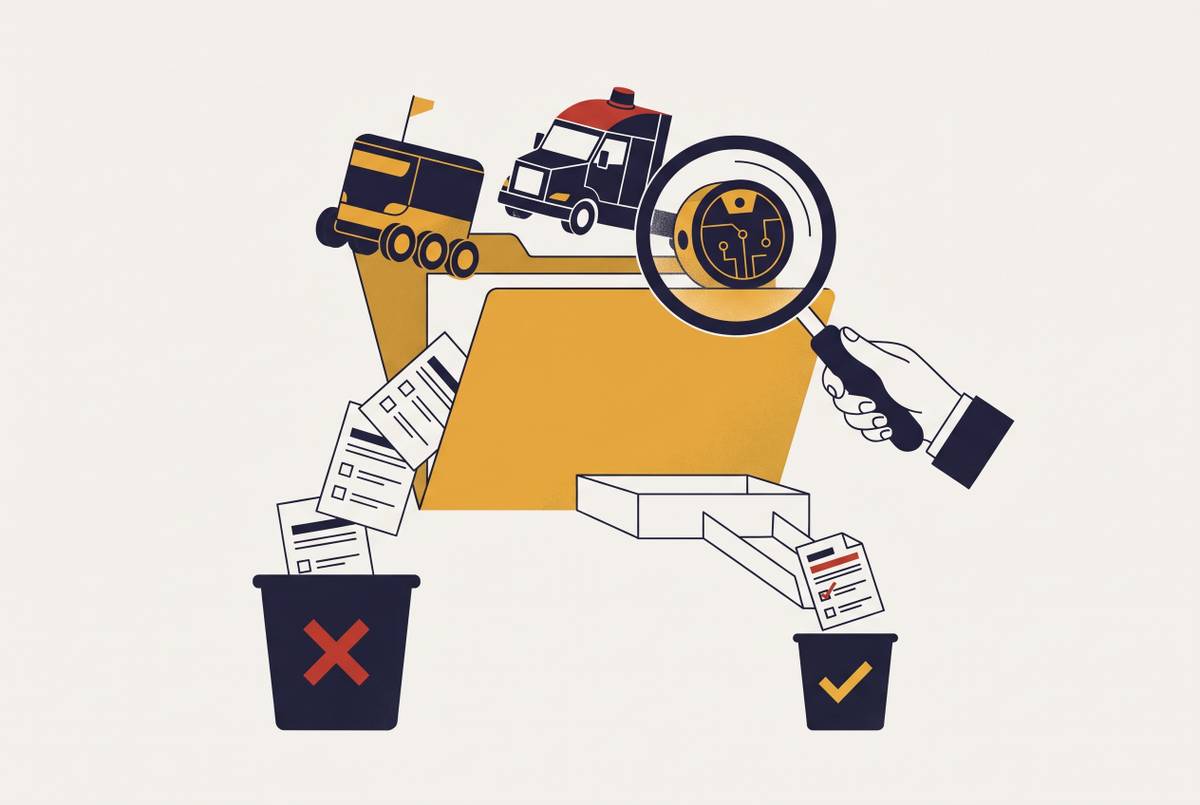
An AV insurer needs a description of the system. A generic commercial auto submission emphasizes the vehicle, while a generic technology-company submission can miss how software decisions translate into physical operation. Neither gives the underwriter enough information to assess an autonomous fleet. The practical approach is to organize the submission around the deployed autonomous driving system, its operating envelope, and the evidence supporting its performance. Without that detail, underwriters may price conservatively or decline.
The deployed software version is the first anchor. Underwriters need its track record, version history, and update cadence because performance evidence must relate to the system being insured. A fleet-level description without version detail obscures the changes that can alter vehicle behavior. Presenting those records well gives the insurer a basis for assessing the current exposure rather than treating all software configurations as interchangeable.
Incident records supply the corresponding performance history. Operators that have reported since early deployment can bring NHTSA-mandated crash reports and California DMV-mandated disengagement reports to insurers as evidence of their operating history. Without that history, the underwriter must price with less information. A strong submission links the record to the ADS version to be insured.
Operational Design Domain documentation defines the boundary of that assessment. It needs to state the geography, weather, speed, and road types under which the system is certified to operate, because coverage should attach within that envelope. Real-time telematics then provides information about system engagement rates, sensor performance, and software versioning. These inputs address different underwriting questions. The ODD sets the conditions in which the system may operate, while telematics helps show how the exposure changes with the software.
Hours in service, geofence boundaries, depot security, and inspection records describe how the fleet is deployed and maintained. A vehicle that overnights in a documented, camera-covered facility presents differently from one parked on a public street. Governance controls belong in the submission for the same reason, giving the underwriter information about how the operation is managed. Submission quality improves pricing and scope because the insurer receives the information needed to assess the actual risk.
What to do before signing the operating agreement — and before binding the coverage
Operators should read the insurance requirements set by the network, depot operator, and enterprise or government customer before choosing coverage. Each relationship can determine limits, lines, and endorsements that a generic placement would miss. The objective is to establish the obligations while the program can still be shaped around them. Binding first leaves the operator trying to reconcile an existing policy with requirements it was not designed to satisfy.
The next step is to identify the highest obligation. Operators should compare the contractual requirements with those of every jurisdiction in the planned footprint and build the shared program to the most demanding standard. If a single umbrella is intended to satisfy all contracts, a lower limit elsewhere cannot substitute for California’s $5,000,000 CPUC minimum where that requirement applies.
Operators should choose a broker and prepare the submission while they negotiate the contract. Autonomous livery coverage is a specialist market, and finding a willing carrier takes time, particularly for a fleet not yet operating at scale. Operators should start that conversation earlier than the contract timeline appears to require and use a broker familiar with autonomous operations, such as Risklytics, a commercial insurance brokerage for robotics and autonomous hardware companies that builds each submission around the deployed system so it is not misfiled into generic forms. At the same time, operators should gather incident history, ADS version records, ODD documentation, and governance frameworks. These records are not quick additions to an otherwise finished application.
Before binding, operators should check that each coverage line for the operation has affirmative AI and autonomous operations language. Tech E&O, cyber, CGL, and product liability policies must be read for what they explicitly cover. This final review compares what the contract requires with what the insurer promises to cover. The decision to bind should follow that comparison, with the operating requirements established and the system’s risk documented, rather than leaving either question to the claims process.