Insurance for ADAS-Equipped Trucks vs. Full Autonomy
Driverless trucks need layered coverage that driver-based fleet policies cannot provide.
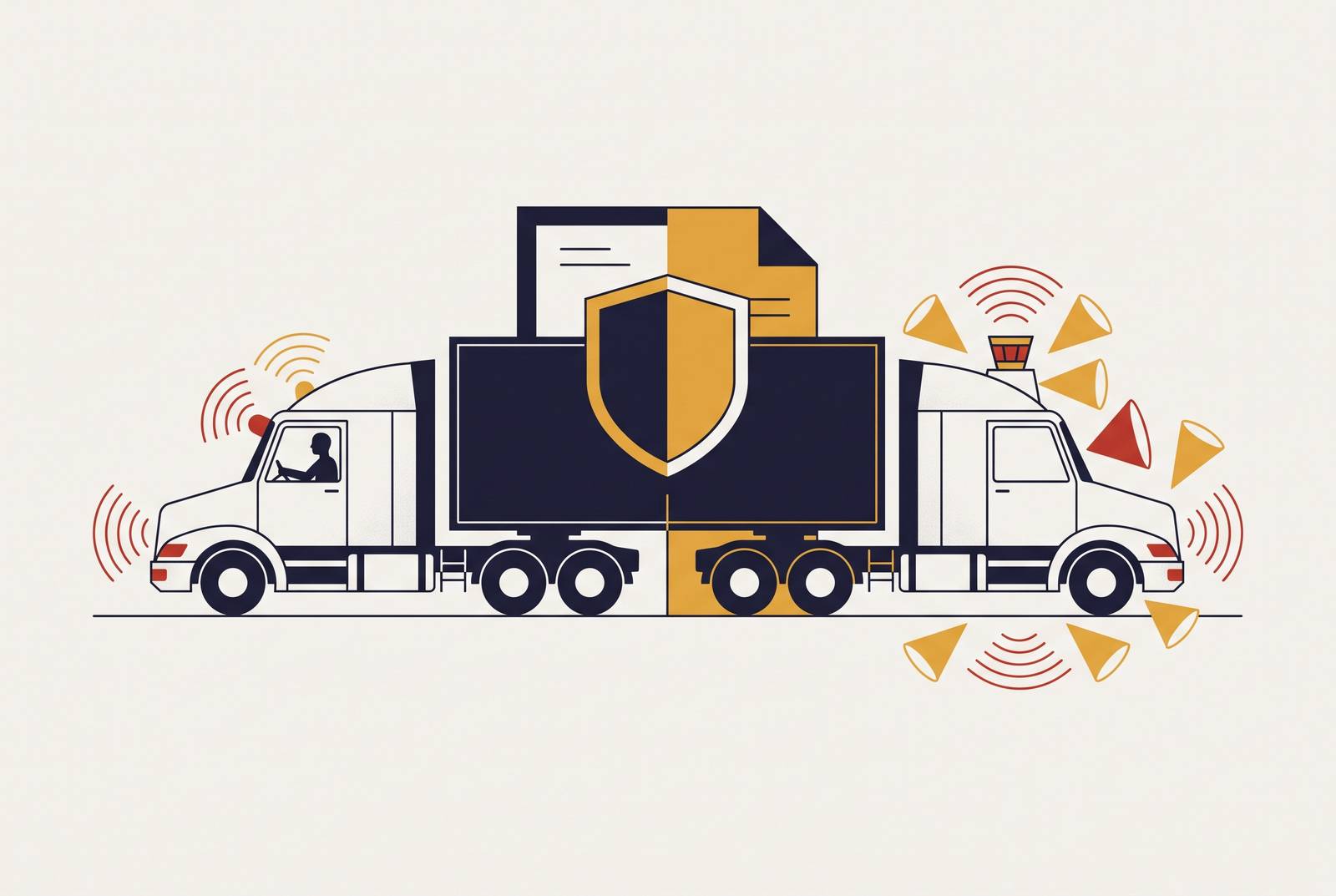
ADAS-equipped trucks and fully autonomous trucks require different insurance architectures because responsibility changes when the human driver leaves the risk equation. Underwriting submission quality for autonomous hardware depends on documenting what the system controls, how its software changes, and how liability is allocated among the parties behind it. A generic fleet or general liability submission cannot establish whether coverage reaches those exposures, which is why specialist brokers such as Risklytics, a commercial insurance brokerage for autonomous hardware companies that builds each submission around the actual operation so the account is not misfiled into a generic form, exist.
Why ADAS trucks and fully autonomous trucks are an insurance category error waiting to happen
Two trucks travel on the same interstate, one with a driver using lane-keep assist and the other running driverless. Both use sensors, cameras, and onboard compute. From outside the cab, both may look self-driving, and both may be sold as autonomous trucks. Treating them as points on a single insurance continuum conceals the difference that determines how a claim will be handled.
In a Level 2 ADAS truck, the human driver retains legal supervisory responsibility for every mile. In a Level 4 truck operating without a driver, fault may instead rest with the ADS developer, sensor supplier, software vendor, or remote operations team. The motor carrier’s commercial auto policy does not cover those parties by default. The policy starts from a different premise. Its driver-liability logic cannot, by itself, address responsibility distributed across the technology and services that replace the driver.
Where the SAE level threshold actually breaks the coverage
The Level 2-to-Level 4 divide is a coverage threshold. At Level 2, the driver still has a duty to supervise, which gives commercial auto a familiar basis for covering a crash. At Level 4, autonomous operation removes that human duty from the cab. Fault must be assigned elsewhere in the system. Level 3 adds a separate ambiguity because the system drives while the human must remain ready to retake control, leaving disputes over attentiveness at handoff.
Deloitte’s 2023 analysis identifies software errors, manufacturing defects, network outages, GPS flaws, failing sensors, and cyberattacks as possible accident causes in technology-driven vehicles. These causes may fall within product or professional liability coverage, with premiums shifting across several lines and commercial auto continuing. Pearl Insurance also says manufacturers, software developers, and systems integrators may be responsible. This changes the coverage inquiry. Identifying the responding policy requires considering the cause and the party involved alongside the truck involved in the collision.
A hub-to-hub operation makes that distinction concrete within a single trip. Human drivers handle the first and last mile, while the driverless truck handles the defined highway segment on approved lanes. The truck and cargo continue, but control changes. Coverage adequate for the human-driven segment may not apply during autonomous operation if the policy does not address that use. The handoff is therefore an insurance boundary as well as an operational one.
How the party structure of a driverless-truck claim differs from a conventional one
An adjuster investigating a conventional trucking collision starts with a relatively short party list, including the driver, motor carrier, and possibly a shipper. Fault investigation follows an established pattern, and the coverage chain is comparatively predictable. A driverless collision opens a much longer investigation. The vehicle owner, ADS developer, sensor suppliers, software update vendor, remote assistance team, mapping data provider, maintenance vendor, and cargo principals may all enter the claim. Their indemnification agreements also need review because those contracts set out how liability passes among them.
The adjuster must distinguish causation from contractual responsibility and available insurance. Each principal may have a different policy, or no relevant policy at all. A motor carrier’s coverage does not resolve that fragmentation. Overlaps and gaps between policies create room for disputes and denials, even when the physical event is clear. Deloitte notes that assisted driving already makes causality harder to assess, and removing the driver multiplies the parties whose contribution may require investigation.
Technicians, remote-support staff, and local drivers still work with the autonomous system even when no one is in the cab on the highway segment. Their work does not map neatly onto a conventional driver workers’ compensation program. The insurance structure must reflect the people supporting the system.
The coverage lines that a fully autonomous truck program requires beyond commercial auto
A fully autonomous truck program needs a stack of coverage lines, each addressing an exposure the others may not reach. Commercial auto remains the foundation, but its language must expressly accommodate autonomous operation. The first audit concerns how the policy treats the ADS as an operator. Endorsements alone do not show that the coverage is enough. Safeline Insurance advises fleets to speak with their provider before deployment because standard trucking coverage may not automatically address autonomous technology, cyber liability, or product liability.
On top of that foundation, product liability or Tech E&O for the ADS developer covers harm caused by software errors, sensor failures, and algorithm defects. These lines reach technology fault that a driver-centered policy may not cover. Cyber protection covers a different set of risks. It cannot be assumed to follow merely because the insured product is software-driven, particularly when network failures and cyberattacks can contribute to a vehicle incident.
Physical damage schedules must reflect the replacement value of sensor arrays, LiDAR stacks, compute modules, and the full hardware kit, which can be a multiple of the truck’s own value. A conventional schedule can severely undervalue that equipment. Motor truck cargo coverage and contractual cargo limits also need review because the carrier still has cargo obligations when the truck runs driverless. An ADS-originated loss may test wording written with a human driver in mind.
CGL completes the stack without replacing those specialized lines. ISO generative AI exclusion endorsements CG 40 47, CG 40 48, and CG 35 08 may remove protection for generative-AI-driven incidents. Their relevance depends on the operation and wording. Where that exposure exists, a CGL policy without an affirmative AI carve-back may offer less protection than the policyholder expects.
What the ADAS truck’s coverage program looks like by comparison — and where it silently fails
An ADAS truck fits more cleanly into a conventional commercial auto program because the human operator remains legally responsible. The architecture is simpler, but it is not complete by assumption. Documented system activation rates, event frequency, and collision mitigation records can improve underwriting terms by distinguishing a fleet using ADAS from one that merely has the hardware installed.
The less visible failure occurs when the system overrides driver input and causes an accident. That claim can spill into product liability even though the fleet policy was written around driver fault. Most ADAS-fleet commercial auto policies have no endorsement addressing that transition. The cause of the accident can still lead beyond the policy’s assumed allocation of responsibility.
Some units have full ADAS packages while others do not, yet the insurance file may fail to show which systems are installed on which trucks. Some vehicles are therefore effectively unrated for their actual risk. This gap begins before a claim occurs. Without unit-level records, the underwriter cannot distinguish the equipment profile across the fleet, and the operator cannot rely on the file to represent the vehicles being insured.
How regulatory minimums establish a floor that enterprise and government contracts then raise considerably
Regulatory requirements set the terms for permission to operate, while a customer contract may call for more insurance. California requires a $5 million commercial liability bond for companies that test or operate autonomous vehicles, while Florida’s minimum for fully autonomous vehicle networks is much lower. Requirements also differ in their treatment of responsible parties. The Library of Congress reports that Germany’s 2021 Autonomous Driving Act requires registered keepers of Level 4 vehicles to obtain additional liability insurance for the technical supervisor. One standard fleet template cannot show all those different duties.
Enterprise logistics customers, defense agencies, and port operators can require far more coverage than the state minimum. Their contracts increasingly call for higher commercial auto limits, Tech E&O with AI-affirmative language, cyber liability with minimum limits, and indemnification provisions that send liability back to the technology developer. Compliance therefore has two distinct tests. Meeting the legal minimum does not establish that the operator can produce the coverage confirmation required by the customer.
Without confirmation of AI-specific coverage, a startup may have to leave an enterprise opportunity or absorb the exposure through its own contract terms. That choice also reaches the board. Government contracts, large enterprise deals, and indemnification-heavy partnerships create D&O exposures, while AI governance failures have become an explicit underwriting criterion at renewal.
Why insurers are still catching up — and what purpose-built AV insurance structures look like when they emerge
Existing forms assume human causation, driver liability, and a single responsible operator, while autonomous trucking distributes control among hardware, software, and service providers. Product development has not kept pace with deployment. Qover states that insurers are adapting existing products for assisted driving but will need entirely new structures as the technology advances. Until driverless operations produce loss data at scale, what insurers do not know may lead to higher premiums and specialized policies that are harder to place.
Purpose-built AV programs begin to address that fragmentation by bringing participants under a single master policy. The shared policy is designed to reduce overlaps and gaps so each developer, fleet operator, and manufacturer can get coverage together. Prices can be based on the risk per mile, delivery, or trip. Deloitte anticipates premium movement across commercial auto, product and professional liability, and cyber, against $34.9 billion in average annual commercial auto premiums generated over the past decade.
Silent AI describes implicit protection in the absence of a specific policy exclusion, a position that is increasingly unstable at renewal. As insurers add AI exclusions, a policy that previously covered an autonomous-system failure may not do so in its next term without affirmative language. Policyholders need to check how the wording changes even when their operation stays the same.
What makes a strong underwriting submission for an autonomous trucking operation?
The practical response is to make the submission describe the actual operation rather than force it into a conventional fleet category. Submission quality is the most controllable variable in obtaining coverage that matches autonomous hardware risk. For ADAS fleets, that work starts at unit level. The submission must identify installed systems and cross-reference them against the current insurance file so that mixed-fleet differences are visible before underwriting begins.
For fully autonomous operations, the submission must explain the ADS at feature level, its software versioning history, over-the-air update protocols, remote operations staffing, and cybersecurity controls. It must also set out contractual indemnification among the principals in the liability chain. Technical detail alone is insufficient. An underwriter needs both the system’s decision-making role and the allocation of responsibility when that system causes harm. A broad description of a company that sells AI-driven hardware leaves both out.
AI governance documentation adds evidence of how those exposures are controlled. Underwriters now request tool and model inventories, board-approved governance documents, data-leakage safeguards, human-oversight checkpoints, and pre-deployment testing evidence, including red-teaming records. Structured governance can produce materially better terms. The submission must also explain how exposure evolves from binding through software updates and changing usage during the policy period.
Finally, a specialist broker must read the actual policy language before it binds. That review is where an autonomous-operation exclusion, removal of silent AI protection, or an understated sensor hardware schedule can be caught. Placement is complete only when the description submitted and the coverage wording address the same operation.