Contractual Insurance Demands From Restaurant and Retail Partners
Partners demand machine-specific insurance that standard policies don't automatically provide.
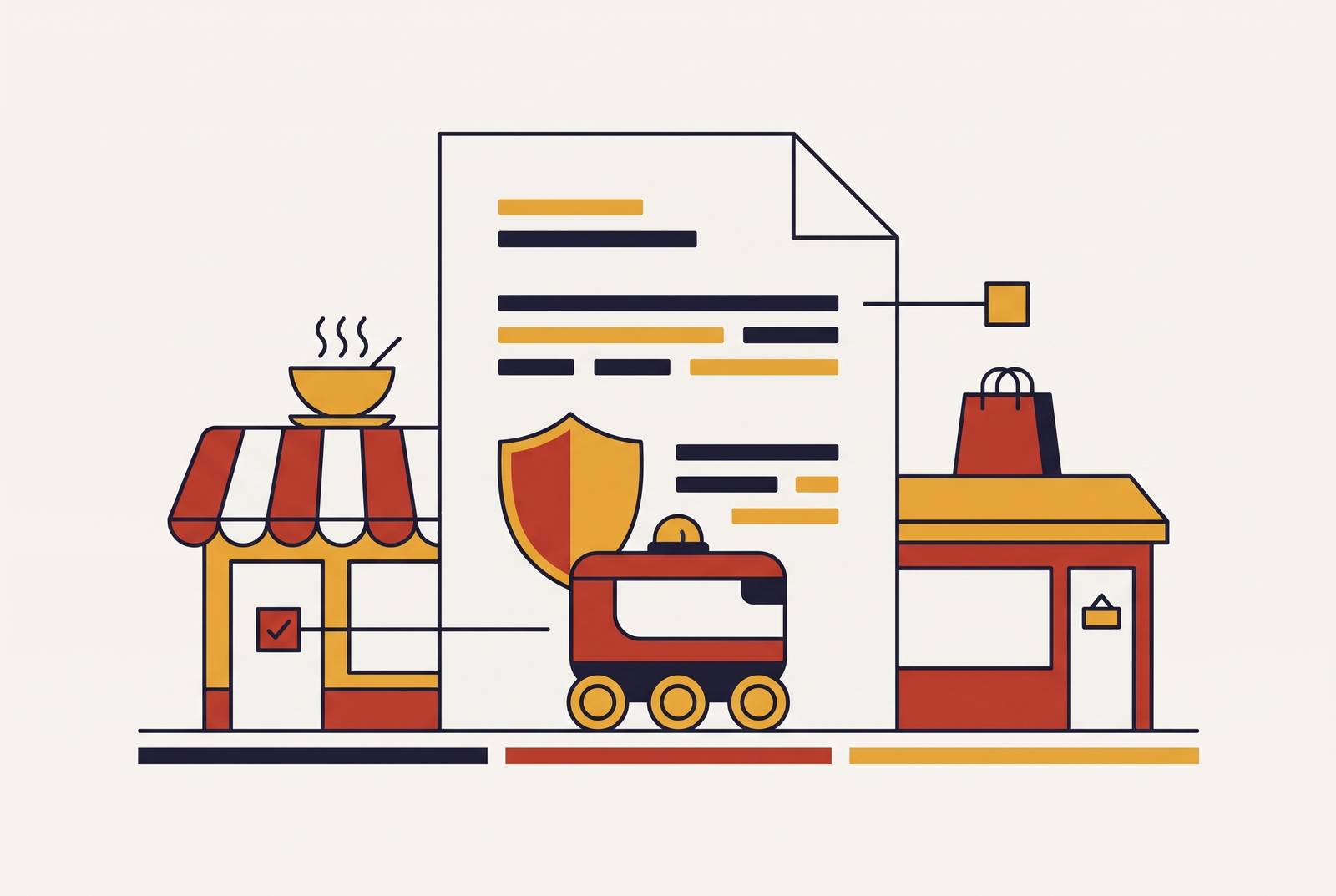
Inland marine coverage for deployed robot fleets is designed to protect the operator’s own hardware at customer sites and in transit between job sites, with policy terms deciding the scope. It is separate from the liability insurance and endorsements restaurant and retail partners require for access. Getting through the gate takes more than a certificate: the coverage must meet the deployment contract’s terms.
Why restaurant and retail deployment contracts have become an insurance problem for autonomous system operators
A company has a pilot agreement with a restaurant chain or a retail rollout in hand, and the partner’s legal team returns a page of insurance requirements. The machine can enter only once those requirements are met. What looked like a deployment milestone has become a coverage problem, because the agreement demands more than evidence that the operator bought commercial insurance. It specifies the protection the chain expects when an autonomous system operates on its premises.
The mismatch starts with how responsibility is divided. When a machine injures someone or damages property, the premises operator, machine maker and software developer can all face liability from the same loss. The site owner’s contract seeks to push as much of that exposure as possible onto the deploying company. Its insurance schedule supports that transfer by requiring coverage and endorsements intended to protect the chain as well as the operator.
Standard commercial policies were written for businesses run by people. They do not automatically provide the protection that a restaurant or retail contract assumes exists for autonomous operations. The central difficulty is not simply price. An operator can have insurance in force and still lack the required scope, limits or endorsements, leaving a non-negotiable access condition unmet. The policy must fit both the machine’s work and the obligations the company is preparing to accept.
What restaurant and retail contracts actually require, line by line
The first line of a requirements schedule commonly asks for proof of general liability insurance at stated minimum limits. This addresses the liability side of the deployment, where a robot can injure a person or damage the customer’s property. The next line often requires additional insured status for the restaurant or retail chain. That protection must be explicitly endorsed so that the chain has protection for defense costs when it is named in a covered claim arising from the deploying company’s operations.
A waiver of subrogation serves a different purpose. It prevents the deploying company’s insurer from recovering against the site owner after paying a claim. The chain gains protection against that recovery, while risk shifts back to the operator and its carrier. Another line often calls for advance notice before cancellation so the partner knows the insurance that allows site access is ending. These provisions are separate requirements, rather than different ways of asking for the same proof of insurance.
General liability addresses claims against the business, while equipment coverage, written as inland marine, is designed to protect the business’s own robots at customer sites and in transit. A machine can damage the premises, but it can also be damaged itself, including being crushed in transit or dropped from a dock.
Equipment coverage is the operator’s gap to address under this schedule. A property policy that stops at the operator’s own walls does not solve the problem of hardware deployed on a partner’s floor. For a fleet working across multiple locations, the relevant distinction is therefore between protecting others from the robots’ operations and protecting the robots themselves. Inland marine is designed to protect the robots themselves, but its terms decide which sites, movements and losses it covers.
Why the limits stated in contracts are often higher than a standard policy carries
Restaurant and retail agreements can call for higher limits than a startup or early-deployment company bought under a standard commercial policy. A lower limit may have controlled the insurance bill when the business first purchased coverage, but it does not change the minimum in a later customer contract. The operator must bring its limits up to that minimum. Otherwise, the company can be technically in breach before its equipment starts work.
Enterprise agreements often call for higher minimums for technology errors and omissions, or tech E&O, and cyber coverage as the size of the contract grows. Typical enterprise contracts call for $2 million to $5 million per occurrence. These are requirements specific to those coverage lines in typical enterprise contracts. The comparison must remain line by line. A sufficient limit on one policy does not establish that another meets the agreement.
The umbrella layer often exposes the next shortfall. A primary general liability policy at a standard per-occurrence limit may satisfy a small venue, while a national chain’s multi-site agreement can require aggregate limits that need an umbrella or excess policy. The number of required coverage lines may appear unchanged, yet the insurance program needed to support them is different.
Broad indemnity clauses and uncapped liability provisions can create legal obligations beyond the policy’s stated limit. The contractual obligation and the insurance limit are separate numbers, and neither establishes whether a particular claim is covered. A policy responds to losses it was designed to cover, subject to its terms. Increasing a limit can address a dollar shortfall, but it does not by itself insure every obligation the contract creates.
How AI exclusions in standard policies make the contract requirements even harder to satisfy
An AI exclusion can defeat coverage even when the required lines and limits are present. Such exclusions are appearing at renewal across general liability forms, with state regulators approving more than 80% of requests to remove AI liability from standard commercial policies in 2026. The policy can retain the insurance category the partner requested while excluding the autonomous decision-making involved in a claim. More insurance dollars on paper do not repair that exclusion.
A certificate of insurance can display the correct coverage lines and limits without revealing an exclusion that removes protection when a claim involves the robot’s decision-making. The site owner can accept the certificate and approve deployment without discovering the gap. If a loss then occurs, the discrepancy affects the partner relationship as well as the operator’s finances, because the chain expected the agreed insurance protection to support site access. The paperwork and the policy can point in different directions.
Silent AI creates a parallel uncertainty in policies that neither expressly cover nor exclude AI risk. Silence is not an affirmative grant of protection. An operator may believe its autonomous operations are covered, and its partner may treat the certificate as sufficient, without either having resolved how the policy would respond. That doubt can go unnoticed until a claim is denied.
The AI exclusion tracker provides a live resource for following this market change. It does not replace the terms of an individual policy. Its relevance to contract review is that exclusion language is an active placement and renewal issue, rather than a question settled when a company first bought insurance. A contract can keep demanding the same protection while a renewed policy narrows what it provides.
What a generic broker submission misses that a restaurant or retail partner's contract exposes
A generic underwriting submission does not communicate what an autonomous system actually does. Without that information, an underwriter cannot make the proposed coverage fit the risks of the deployment and the terms of the contract. Which insurance line applies depends on whether a robot injures someone, damages a customer’s property or is damaged itself. The submission must make those differences visible if the resulting program is to fit the work.
The contract has details that a general application leaves out. Additional insured status, waiver of subrogation and cancellation notice are specific requirements to request and confirm at placement. A broker who has not read the agreement cannot know which endorsements to seek for that deployment. A certificate requested later cannot add terms missing from the policy. The contract is therefore an input to placement.
Knowing that a company owns robots does not show that its equipment coverage covers machines working at customer sites or traveling between them. Nor does it establish that liability coverage responds to their autonomous operations. The fleet’s physical exposure and the partner’s liability requirements need separate treatment within the submission. Otherwise, a placement can address one while leaving the other unresolved.
Specialist placement follows from these mechanics, rather than from a general preference for a particular kind of broker. A broker working with autonomous systems needs to connect the deployment description, the contract and the proposed policy terms. Timing is part of that work as well. Fewer carriers have appetite for autonomous systems, so these placements take longer than standard ones. Beginning only when a partner requests a certificate leaves less room to resolve an endorsement or coverage shortfall before it delays the pilot.
What operators deploying into restaurant and retail sites should verify before signing the contract
Before signing, operators should compare the partner’s insurance schedule with the actual policy terms, line by line. That review should distinguish required coverage from the limits and endorsements attached to it. The comparison belongs before the deployment date is fixed. At that stage, a shortfall is easier to address than after the company has accepted the obligation and the partner is waiting for a certificate. The aim is to identify what is already insured and what still needs placement or clarification.
Read the indemnity clause with the policy as well. Broad indemnity language and performance warranties can create contractual liability beyond common law, and an E&O or cyber policy may not respond to that added obligation. The contract creates the duty, but the policy decides whether insurance supports it. This review should keep the amount of potential liability separate from the amount of available insurance. Neither figure alone shows whether the policy covers the obligation.
Confirm that additional insured status, waiver of subrogation and advance cancellation notice are actually included in the policy. A certificate can state those requirements without the corresponding endorsements having been added to the underlying form. For robots that move between job sites and work at customer locations, check that the inland marine terms cover the risks to the hardware where it works and while it is in transit.
Check renewal terms before counting on coverage agreed to in the past. An AI exclusion can be added at renewal even if the prior policy covered autonomous operations, while a new certificate continues to show the expected lines and limits. Describe the deployment in plain terms to a broker who works with autonomous systems, including where the robots operate, how they move between sites and what the partner requires. Do that before the contract is countersigned.