What the Inland Marine Insuring Agreement Actually Says About Autonomous Robots in Transit
Inland marine follows robots between sites, but its exclusions leave gaps.
Inland marine coverage for deployed robot fleets covers physical loss or damage while the equipment moves between job sites and works away from the insured’s premises. But open-perils wording does not, by itself, cover the full exposure of an autonomous machine. Closing that gap requires a coordinated insurance program drafted around autonomy, with property, liability, auto, and cyber terms that account for one another’s exclusions.
What inland marine covers for autonomous robots traveling between job sites
Inland marine is the standard commercial starting point for equipment that moves beyond a fixed premises. Its name comes from cargo insurance, but its modern function is to follow property into the field. For a robotics company, that includes hardware in transit, at job sites, and on pilots or demonstrations. The equipment moves, and the coverage follows it.
The form fills three gaps in standard property coverage: property that travels between locations, property at job sites or temporary locations, and property that belongs to someone else but is in the insured’s care. That last exposure is addressed through bailee coverage. The insuring agreement generally operates on an open-perils basis, covering physical loss or damage from causes not specifically excluded. Rather than requiring a loss to match a short list of covered causes, the form makes its exclusions central to the coverage analysis.
Why the open-perils structure is narrower than it appears for autonomous robots
Those exclusions were written for passive equipment, but an autonomous robot can move, decide how to act, and cause injury. The distinction changes how a loss reaches the policy. A damaged machine may look like an ordinary equipment claim, yet its operation can bring exclusions into play that a conventional piece of transported hardware would not encounter. Three boundaries matter most here: highway-vehicle treatment, mechanical breakdown, and third-party liability.
The highway-vehicle exclusion is designed to put machines that travel on roads under commercial auto. An autonomous robot can encounter that boundary when it moves under its own power across a road, a parking lot, or a public right-of-way. Depending on the wording and classification, the exclusion can become relevant even when the robot is not licensed for highway use or is traveling on a flatbed. Being physically in transit does not, by itself, establish that the inland marine form will respond.
Mechanical breakdown creates another point of tension when a collision involves a failure in the autonomy stack. At the same time, inland marine does not insure bodily injury or property damage the equipment causes to others. Those claims ordinarily belong on the liability side. A single collision can therefore raise a breakdown exclusion for the robot’s damage, an auto exclusion because of its self-propelled road use, and a third-party injury claim. Without coordinated wording, that event can fall between inland marine and commercial general liability, or CGL.
How the classification problem compounds the exclusion problem
The exclusions are not simply isolated defects in otherwise suitable forms. They reflect a deeper classification problem. An autonomous robot combines physical property, vehicle functions, software, and cyber exposure, while standard policies divide those risks into separate lines. When a loss occurs, the same event can be described as a property loss, a vehicle accident, a software error, or a cyber incident. Each description directs attention to a different insuring agreement and a different set of exclusions.
Classification therefore governs more than the name on the policy. It affects which insurer is expected to respond and whether another policy treats the same loss as outside its scope. A property form does not become liability insurance because the damaged object also injured someone. A liability policy may also leave a loss caused by software or a cyber incident uncovered. The robot is one machine, but the insurance program can divide its operation into incompatible categories.
A unified policy can avoid disputes over which carrier responds by keeping the claim within one contract. Separate policies require deliberate coordination to achieve that clarity. An autonomous operation can need several lines, but assuming that generic forms assembled from different carriers will fit together without gaps creates a risk. Where each policy redirects a loss toward another category, adding policies can produce competing exclusions.
What AI exclusion endorsements are now doing to the liability side of the same program
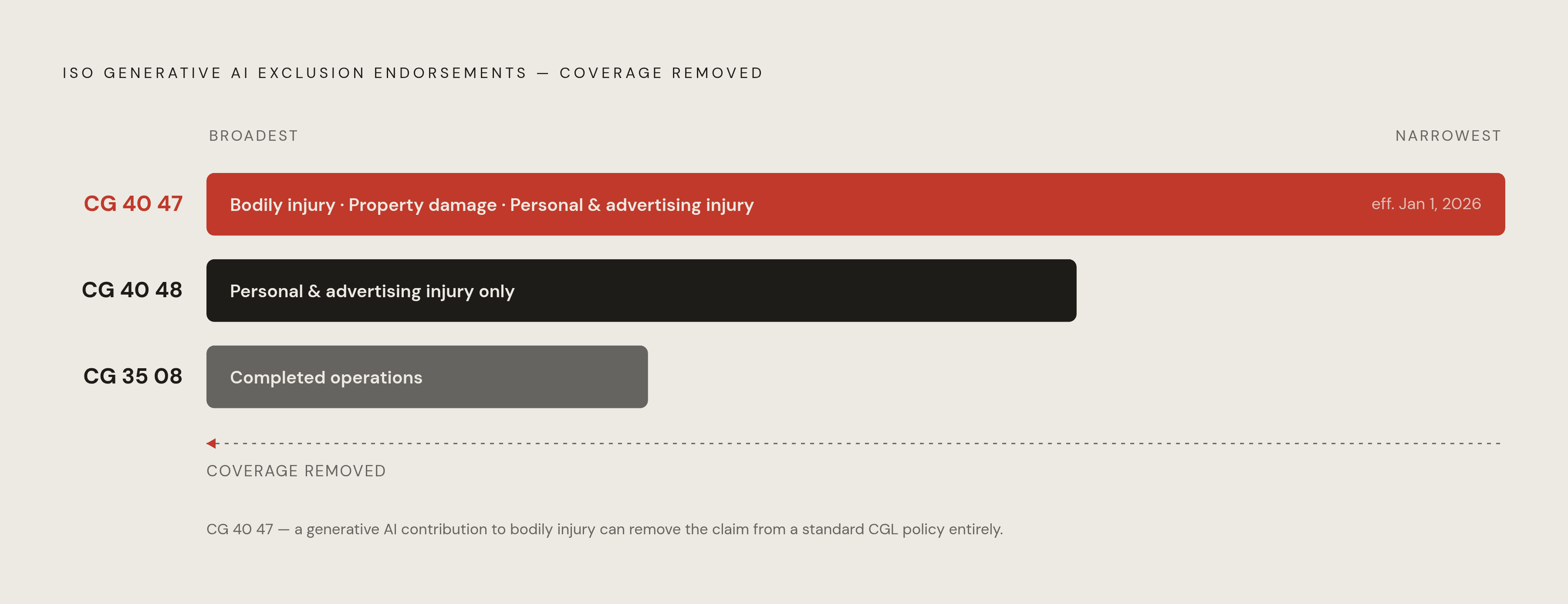
That coordination problem is becoming harder as insurers add AI exclusions to liability policies. The CGL policy meant to cover third-party losses may itself limit claims that involve AI. ISO introduced generative AI exclusion endorsement templates in 2025, and its Generative AI Exclusion for commercial general liability took effect January 1, 2026. When added to a policy, they change what the underlying liability form covers.
ISO’s three versions reach different parts of coverage. CG 40 47 is the broadest, excluding bodily injury, property damage, and personal and advertising injury claims arising from generative AI. CG 40 48 takes away only the coverage for personal and advertising injury under Coverage B. CG 35 08 targets completed operations, the coverage a company relies on after a job closes.
The broadest form’s trigger is especially consequential because a claim need only “arise out of” generative AI. For a robotics company, that wording can put a physical injury or damage claim outside coverage when generative AI in the autonomy stack contributed. The connection to generative AI remains essential. Autonomy and generative AI are not interchangeable descriptions, so whether coverage applies depends on the actual system and the endorsement’s scope, even when the machine is called autonomous.
The Insurability Frontier of AI Risk: Mapping Threats to Affirmative Coverage, Silent Exposures, and Exclusions identifies a broad set of P&C groups filing to adopt AI exclusions across multiple lines, with state commissioners approving the majority of those requests. The paper maps what carriers publicly say they will cover, without showing the wording of signed contracts. That distinction limits what its findings establish about any particular claim. It nevertheless documents a widening exclusion trend that makes the liability side of a robotics program unsafe to treat as an automatic backstop.
What the market's early autonomous-specific products reveal about the gap
Specialist products show that insurers recognize exposures the conventional property-and-liability stack does not address cleanly. Tokio Marine & Nichido Fire Insurance introduced AI robot insurance in November for wheeled, four-legged, and humanoid robots, with premiums about 20% above conventional industrial coverage. Its scope extends beyond damaged hardware. The policy covers repair or replacement after a collision or natural disaster, third-party injury and property damage, and substitute workers’ wages or rental fees for stand-in robots during downtime. Those provisions connect the machine’s physical loss, its liability exposure, and the cost of replacing its work.
Bot Auto demonstrates a different approach to coordination. The autonomous freight operator, running driverless loads between Houston and San Antonio, secured a program underwritten by an A-rated carrier and placed by Marsh. The program includes auto liability, property, general liability, cargo, and inland marine, complemented by a separate cyber policy. Autonomous operation is addressed through a coordinated multi-line structure rather than left to the presumed overlap of standard policies.
The International Group of P&I Clubs provides a useful boundary example. Following the IMO’s adoption of the first global safety code for autonomous vessels in May 2026, the group confirmed that autonomous vessels could access its established insurance pooling arrangements. That marine P&I cover still left out land-based risks. Workplace injuries at remote operation centres, for example, required other insurance.
These examples also show why an “AI policy” is not a sufficient buying specification. The frontier paper shows how affirmative coverage differs across model performance, hallucination liability, IP and tech E&O, and the emerging field of autonomous system liability. Those are different underwriting targets. A product positioned around one does not establish coverage for another. For deployed robot fleets, the carrier’s affirmative coverage needs to match the physical risks the machine faces and the risks of how it works.
Why submission quality determines whether a robot gets covered or excluded
The practical lever for a company facing these gaps is the underwriting submission. A standard commercial application has no fields for how an autonomous machine actually operates, leaving the underwriter without information needed to distinguish one deployment from another. The label “autonomous” is not a risk description. Without an operational account, the application can lead to exclusions or no response.
A company in that position should present the operation through its safety file. Supervision ratios, emergency stops, and incident logs tell the underwriter more than the autonomy label alone can. The safety file and the limits sought are within the company’s control. A submission grounded in those details can earn materially different terms from one that presents only the machine’s category. The aim is to make the operation insurable on its own characteristics rather than leave it to assumptions about autonomous systems.
Bot Auto’s announcement quotes Marsh’s Owen Oakley as saying that qualification for its AV insurance program requires a comprehensive risk mitigation approach beyond standard industry practices. That requirement makes operational evidence a condition of access. A company unable to demonstrate the required approach cannot rely on the program’s existence as proof that coverage is available to it. Conversely, the example shows that autonomous operation can be placed when the risk presentation meets the underwriter’s requirements.
Presentation must also reach a carrier that wants the exposure. The frontier paper’s account of what carriers seek to cover shows why knowing this part of the market differs from simply having access to insurers. An underwriter who focuses on model performance may be a poor fit for a mobile robot’s physical liability. The same operation can receive materially different terms when described properly to an appropriate market instead of being compressed into a generic application.
What a policy drafted with autonomy in mind actually addresses differently
A policy drafted with autonomy in mind starts from the operation rather than treating the robot as passive equipment with an unusual label. Its place in the program is assessed against the other lines’ definitions and exclusions. That changes the coverage task. The objective is not a better inland marine floater in isolation, but a program in which physical loss, vehicle use, third-party injury, software error, and cyber exposure do not disappear between contracts. Each line must be read with the others in view.
For a company placing that program, the necessary step is a licensed broker’s review of every policy before it binds. A certificate of insurance cannot replace that work. A CGL policy with CG 40 47 attached may look identical on the certificate to one without it, even though the endorsement changes the treatment of generative AI-related claims. Reading the endorsements is how the broker identifies that difference. The review must then connect the exclusion to the actual autonomy stack and the protection available elsewhere in the program.
Affirmative autonomous coverage exists, but it remains specialist and requires limits matched to the actual exposure. When choosing a carrier, a company must separate markets that seek to cover autonomous system liability from those adding AI exclusions to standard forms. Broker commissions are typically included in commercial premiums, so a company using a commission-only specialist generally pays no more for that service than one using a generic application process, although some complex placements involve a disclosed direct fee.