One Inland Marine Program for Autonomous Mobile Robots That Cross Warehouse and Client-Site Boundaries Every Shift
Inland marine anchors the program, but only a coordinated set of policies covers every robot loss.
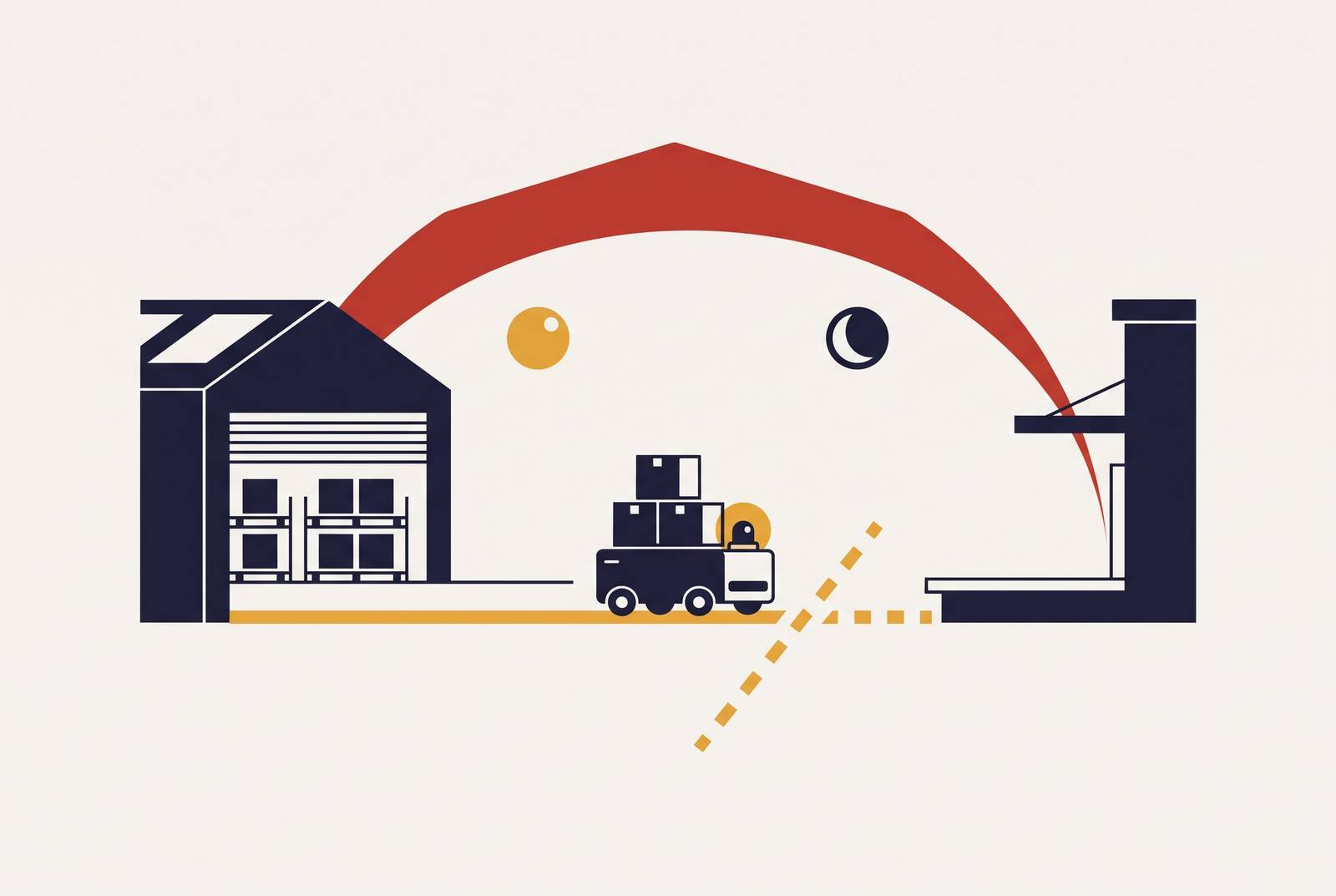
Inland marine coverage for deployed robot fleets protects mobile equipment in transit, at customer sites, and during pilots and demos. For autonomous mobile robots crossing warehouse and client-site boundaries every shift, it is the anchor of a coordinated insurance program. Liability, technology errors and omissions, and cyber coverage must address the losses that equipment insurance alone does not cover.
Why standard property coverage stops working the moment an AMR leaves your building
An autonomous mobile robot leaves the building to begin its shift at a customer warehouse. It may pass through a carrier’s custody, wait in a staging area, and operate on premises its owner does not control. Mobility is the normal operating pattern. Yet standard commercial property insurance is designed around equipment at the insured’s own premises.
That mismatch creates a structural gap at the premises line. The distinction becomes consequential when a robot is crushed in transit or damaged at a customer’s warehouse, where the asset is outside the location around which its owner’s property coverage was written.
Off-site operations also bring the robot into a different claims environment. Physical claims can involve site owners, their insurers, and statutory requirements that a software-only business does not encounter. The machine’s owner therefore faces more than a change of address. Its equipment is exposed to physical loss in places that a premises-based policy was not designed to follow.
What insurance covers autonomous robots traveling between job sites?
Inland marine is property insurance for equipment that moves. Its name comes from cargo insurance history, but its modern function extends to equipment in transit, at jobsites, and on pilots and demos. An AMR fleet operates across locations, and inland marine is designed around that movement.
The coverage is commonly described as a “floater” because it follows the insured property. For an AMR operator, that means the coverage form can accommodate the machine’s journey from its own warehouse to a carrier and then to a customer site. A crated robot disappearing between the dock and the pilot site belongs within the same equipment-risk discussion as a forklift crushing it after arrival.
This makes inland marine a purpose-built form for mobile robotics. Its suitability nevertheless depends on the property and operations described in the policy. Each unit needs to be listed with its replacement cost, and the program needs to reflect where the equipment actually operates.
Why inland marine alone is not enough and what the full AMR program looks like
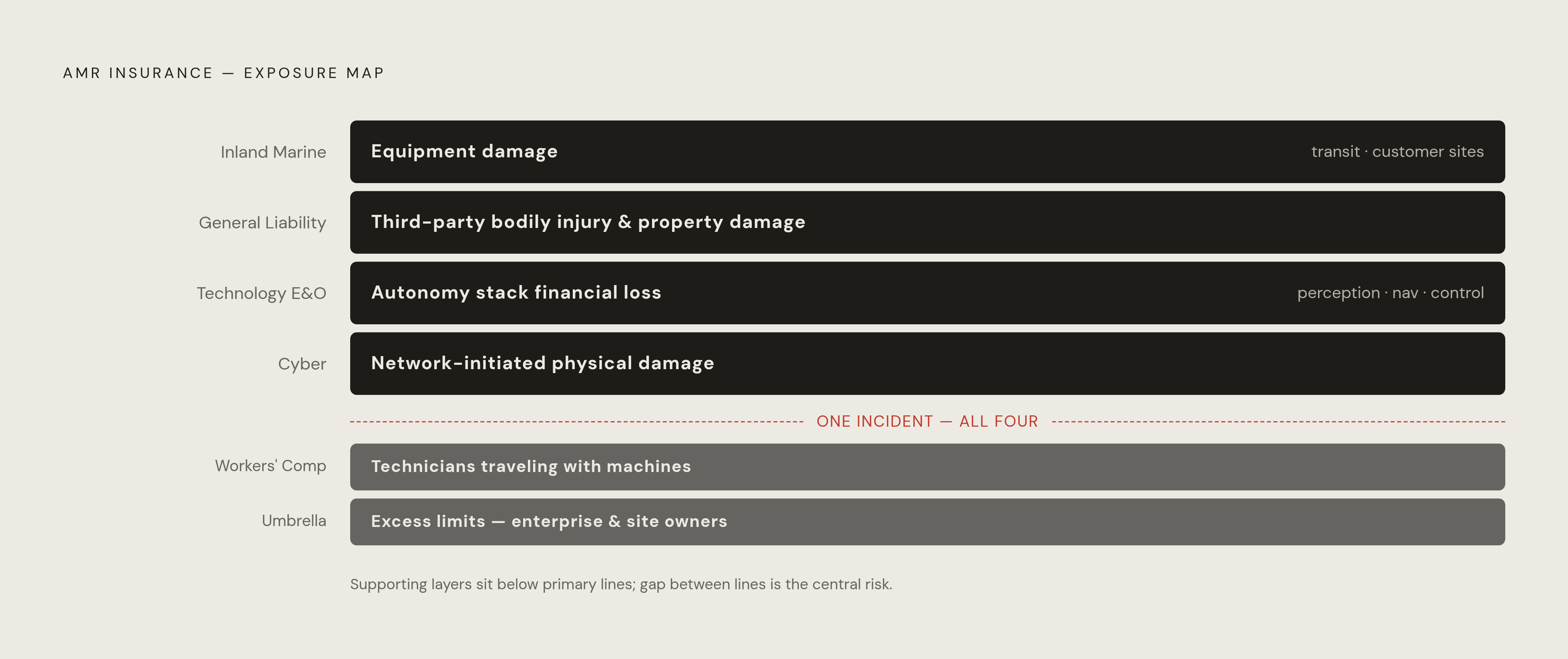
A robot crushed at a customer site presents an equipment loss for inland marine. The same robot injuring a bystander presents a general liability claim. Those are different losses under different policies. Because one incident can damage the machine and injure a person, the program must coordinate the lines around the robot’s working life rather than treat equipment coverage as a complete answer.
Technology errors and omissions, or tech E&O, becomes relevant when the autonomy stack itself is sold or licensed to a customer. A perception model, navigation service, or control policy can cause financial loss that general liability and inland marine do not address. Cyber introduces another boundary when compromised software causes physical damage to the robot. The origin is a network event, even though the result is damaged hardware, so neither a standalone equipment policy nor general liability can simply be assumed to respond.
Other lines address different parts of deployment. Workers’ compensation applies to the technicians who travel with the machine, at the limits state law sets. Umbrella coverage adds limits above primary policies, usually when an enterprise customer or site owner calls for more than the primary lines provide. The purpose is to assign each exposure to a responsive line and identify where the lines might otherwise leave a loss between them.
The specific AMR failure modes that fall between standard policy categories
A navigation or perception failure can turn a wrong decision into bodily injury or property damage. Generative AI exclusion endorsements, including ISO forms CG 40 47 and CG 35 08, create a further question about whether the system and incident fall within the exclusion’s wording. The distinction between an autonomous function and the AI activity described in an endorsement is therefore consequential.
A cyberattack presents a different fault line when an attacker takes over a robot’s controls and causes physical damage. The hardware is harmed, but the initiating event is digital. But a software update or sensor failure may take the machine offline without damaging anything. Production losses can then arise without any property to repair or replace, leaving them outside standard property and inland marine coverage.
Not every failure is sudden or confined to one company. Sensor degradation over time blurs the boundary between maintenance and an insurable sudden loss, while a single malfunction can produce claims against the hardware maker, software developer, and operator. All three parties may share responsibility for a loss that falls outside a single standard policy. These scenarios expose the central weakness of a generic program, whose categories separate physical property, technology, and liability even when the incident combines them.
How the underwriting submission determines whether those gaps are covered or excluded
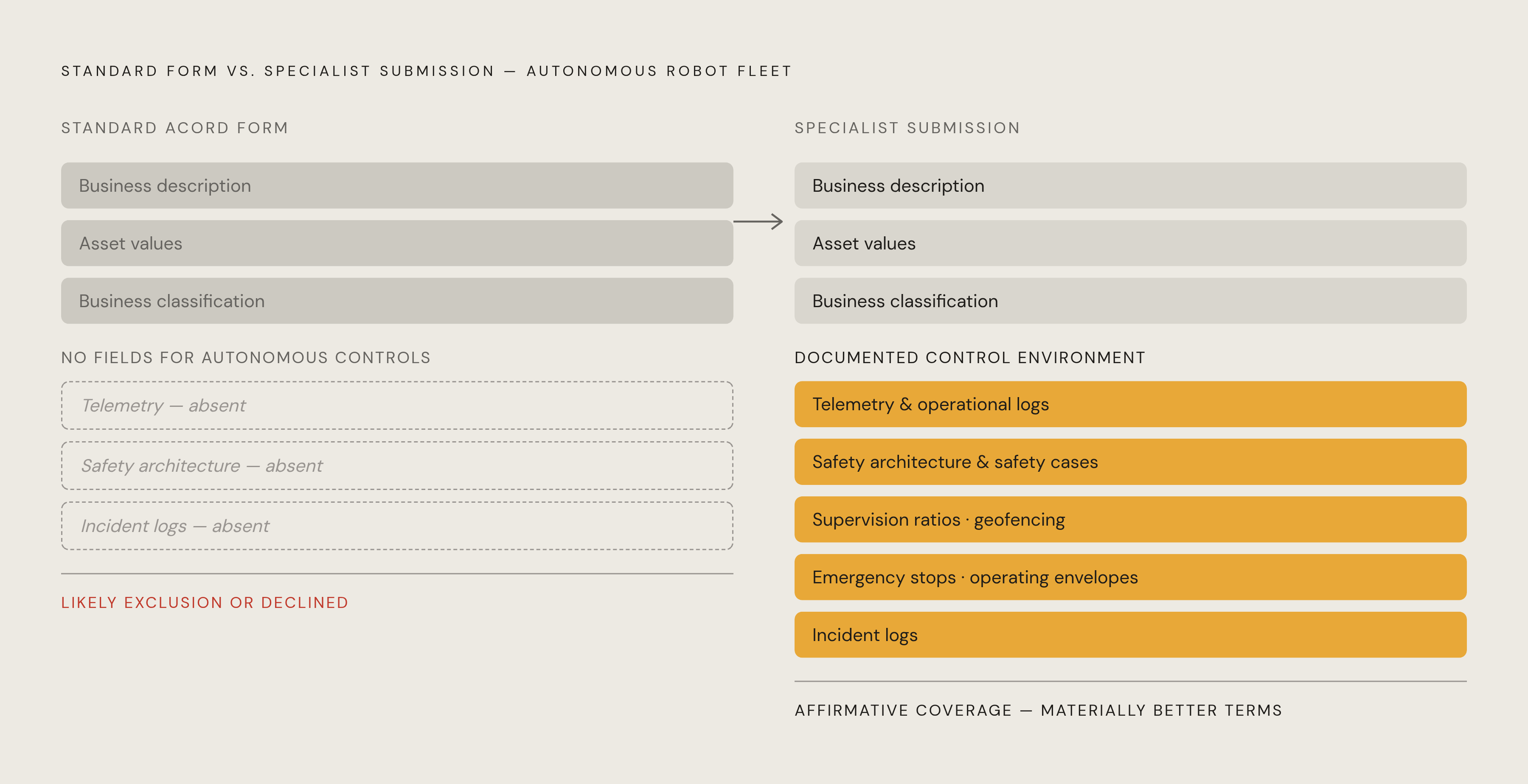
Standard commercial insurance applications have no fields for many of the controls that define an autonomous system’s risk. Supervision models, operating envelopes, geofencing parameters, emergency stops, and safety cases can be absent from the form. That omission leaves the underwriter without essential context. A standard ACORD form may describe the business without describing how its machines are governed.
A specialist submission fills in how the robots work through telemetry, operational logs, and records of the safety architecture. Supervision ratios and incident logs show how governed AI differs from autonomy with no record of oversight. Underwriters can price a documented control environment and often will cover it. Without that evidence, the same operation may receive exclusions or be declined because the submission has not established the conditions under which the robots work.
A submission that documents the controls can earn materially better terms than a generic application describing the same operation. This becomes more consequential as the fleet grows. As a fleet grows, its customer-site profiles, geofencing configurations, and operating environments change what underwriters must assess, and those differences must be shared so that pricing and coverage match the actual exposure.
What enterprise and government contracts now require from AMR operators before the first unit crosses the threshold
Enterprise customers and site owners are making insurance a condition of deployment. Procurement questionnaires already ask for certificates that show general liability and professional liability minimums, and more now list autonomous-system failures apart from general intellectual property or data indemnities. An operator may have a machine ready for deployment but still lack the insurance evidence needed to place it on the customer’s floor.
The operator’s indemnity commitments must also be considered against the coverage backing them. An agreement to indemnify a site owner does not itself create tech E&O or cyber protection when the corresponding loss occurs. Without those lines, the operator may have to pay what it owes without help from its insurance. Contract requirements therefore shape both the limits bought and the failure modes the program must cover.
For EU-facing deployments, the European Union’s Product Liability Directive adds a concrete deadline. The European Commission identifies December 9, 2026 as the deadline for member states to transpose the directive into national law, with the rules applying to products placed on the market after that date. The directive makes clear that software, including AI models built into commercial products, is a product subject to strict liability. Manufacturers cannot use contracts to exclude or limit that liability toward consumers, and joint and several liability applies when more than one economic operator is independently liable for the same damage. That makes the allocation of hardware and software exposure more consequential.
Where the insurance market actually stands on AMR coverage and what the product landscape looks like now
Dedicated coverage is emerging, but deployment is advancing faster than available specialist capacity. Most robotics companies are still underwritten against forms not designed for autonomous systems. Much AI liability exposure sits within “silent cover,” meaning general liability, E&O, and tech E&O policies in which the AI risk was never expressly identified, disclosed, or priced. Silence is not affirmative protection when a claim arrives.
Tokio Marine & Nichido announced its “AI Robot Insurance” on October 26, 2026, with a November 2026 launch. The product covers equipment damage, third-party liability, and business-continuity costs for AMRs that work in a range of environments. Those continuity costs include replacement personnel and rental fees for substitute robots during downtime. Cyber incidents are excluded from the product.
PolySea, a specialty MGA built for autonomous systems, writes warehouse robotics, autonomous trucking, drones, and humanoids using engineering controls and live telemetry as its pricing framework. Its stated AMR program starts with equipment breakdown and inland marine, with other lines to follow. Neither description establishes that every exposure is covered, but each shows how specialist underwriting is moving beyond a generic property schedule.
The market is moving toward submissions that use telemetry and real-time updates to exposure as the mix of robots in a fleet changes. Pricing is becoming more closely tied to operational controls. Operators able to document those controls are better positioned for that approach than operators whose applications describe only asset values and business classifications. Product availability is changing, but the quality of the risk description remains central to placement.
Why structuring the inland marine program correctly from the first deployment matters more than adding coverage later
The first deployment fixes decisions about which lines to buy, what equipment values to list on the schedule, and what to tell underwriters about how the robots work, all of which must be settled before a loss. Values below replacement cost can leave a claim only partly paid. A fleet that grows from two units to ten without updating the schedule leaves the incremental hardware uninsured, even if the original units were correctly covered.
An inland marine policy that does not follow the robot to a customer site cannot be extended retroactively after damage there. Nor can a cyber exclusion be removed after software compromise physically harms the machine, or absent tech E&O be purchased to answer a navigation-software loss that has already occurred. Coverage added later addresses later exposure. It does not repair an uninsured event.
The program needs to be structured around the machine’s operating envelope before the first unit leaves the building. That means listing each unit on the schedule at replacement cost and using a specialist submission with records of geofencing, supervision ratios, telemetry architecture, and incident logs. Specialist broker placement does not add a separate cost beyond the premium under the commission structure described here, because commissions are built into the commercial insurance transaction.
A single inland marine program gives the moving fleet its equipment anchor, but coordinated liability and technology coverage determine how the wider incident is handled.