Why the Equipment Floater Exclusions That Grounded Your Robot Fleet Claim Point to One Fix
Standard floater exclusions miss how robots fail, so specialist forms are the fix.
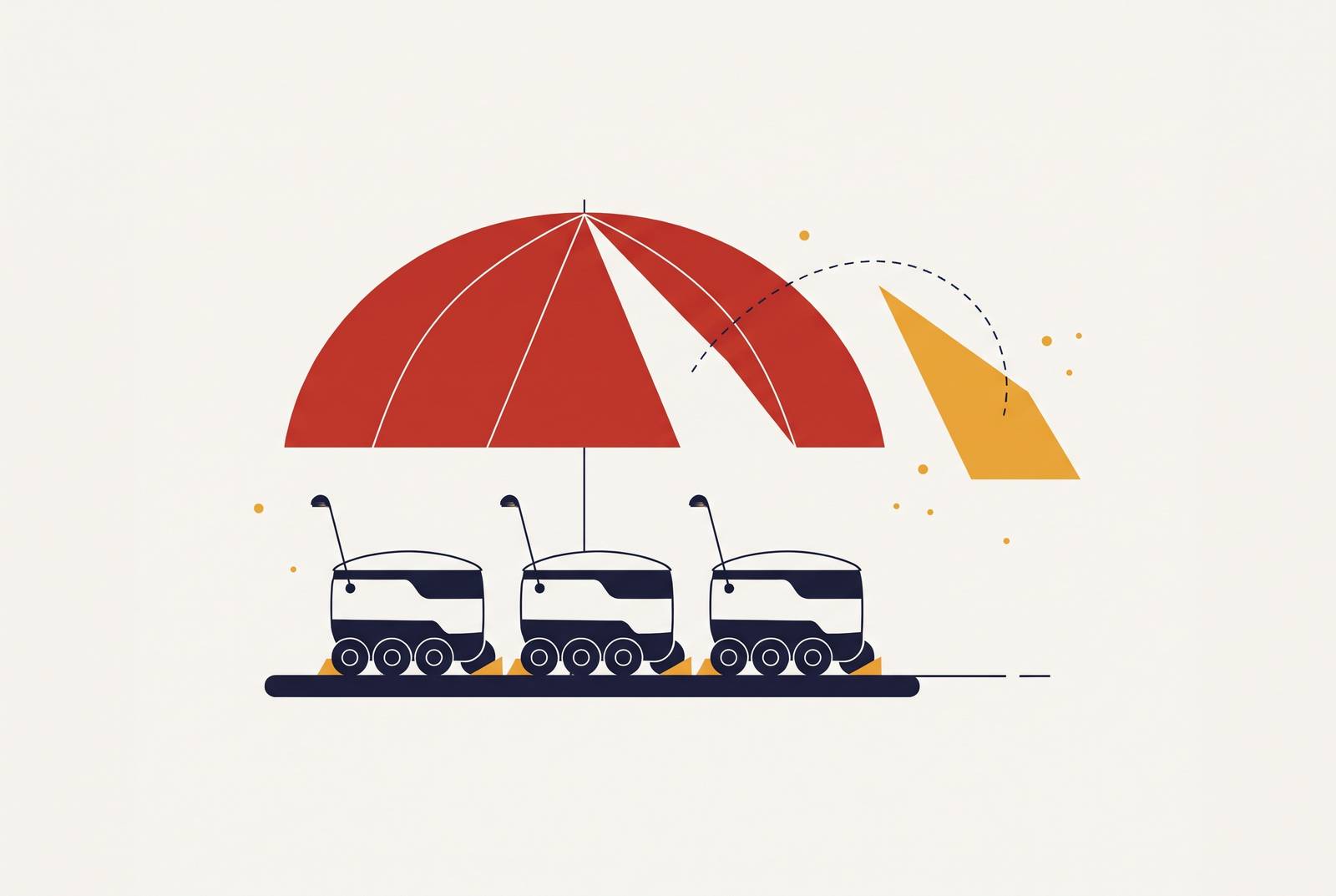
Inland marine coverage for robot fleets in use must cover both mobile property and autonomous failure modes, whether the robots move between job sites or work at several locations. Standard equipment floaters cover equipment that moves, but their exclusions can rule out claims that arise from autonomous operation. The durable fix is a specialist placement built from forms that explicitly address how the systems fail, with coverage determined by the policy terms.
Why standard equipment floaters fail autonomous robot claims before an adjuster even reads the incident report
Standard equipment floaters are inland marine forms that cover mobile business personal property against named or open perils wherever the property is. That makes them a natural starting point for equipment deployed across several sites. Mobility, however, is not the same as operational coverage. The exclusion schedules were written for PLCs, relays, and hydraulic systems, leaving a mismatch with machines whose software interprets an environment and decides how to act. A robot can therefore qualify as insured property even when the coverage bought leaves out the ways it tends to fail.
The legal mechanism sits in the exclusions. Mechanical breakdown, wear and tear, temperature and humidity variation, and loss of use map onto sensor degradation, thermal drift in compute hardware, software-induced downtime, and emergent behavior that produces collisions. For aerial systems, the mismatch can be more fundamental because standard floaters frequently exclude aircraft, a classification regularly applied to drones. The obstacle is then the category of property itself.
A detailed account of the loss cannot supply affirmative coverage that the wording lacks. An unfamiliar robot failure is most likely to fall under the mechanical breakdown exclusion.
How the mechanical breakdown exclusion fires differently when the machine decides for itself
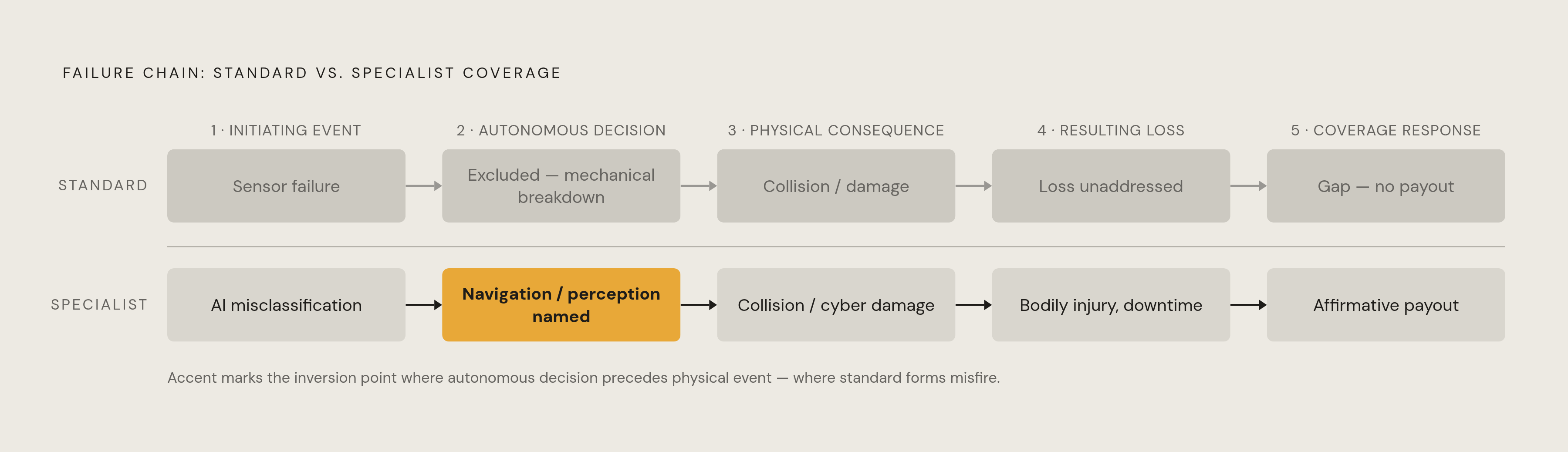
In a typical equipment claim, mechanical breakdown is a physical failure inside the equipment that causes loss. A bearing seizes or a hydraulic line bursts. The exclusion targets predictable failures that maintenance should prevent, and underwriters price its presence into premiums accordingly. The physical component fails first, and the damage follows. That sequence gives the exclusion a recognizable relationship to the machinery it was drafted to address.
An autonomous system can reverse that sequence. A neural network misclassifies an obstacle, the robot acts on that classification, and the collision damages its frame or actuator and surrounding property. The decision precedes the physical event. Although the AI decision is the proximate cause in that failure chain, the insurer may categorize the damaged machinery as mechanical breakdown and apply the exclusion. The coverage dispute therefore turns on whether the form distinguishes an autonomous decision from an internal equipment failure.
Adversarial inputs and model drift expose the same weakness. They can produce physical consequences even though no component malfunctioned in the conventional sense. Emergent fleet behavior adds to the difficulty because robots that each work as they should can act together in ways that cause harm. That loss fits no existing exclusion category cleanly, leaving mechanical breakdown or loss of use as the nearest available classification.
The problem does not require bad faith by an adjuster. The policy language has no clear concept of the AI-based failure that started the chain, so the claim is interpreted through categories designed for other machines. Operators may discover that mismatch only after a denial. A specialist form becomes intelligible at precisely this point because it can expressly address navigation, perception, or software failures rather than leaving their treatment to an analogy with broken machinery.
The aircraft classification trap and why autonomous flight mode exclusions extend the same logic to drones
A floater that excludes aircraft places an aerial autonomous system outside the form rather than accepting the property and then excluding a particular cause of loss. This is a categorical barrier to coverage. It is not simply an omitted failure mode within otherwise applicable protection, and treating it as a routine gap to patch with an endorsement misidentifies the problem.
Autonomous flight mode exclusions add a separate restriction. Some policies restrict or exclude fully autonomous operations or flights beyond visual line of sight. For BVLOS survey work and automated waypoint navigation, the conditions that make the work pay can therefore clash with the coverage terms. Classification and operating mode are distinct tests, and satisfying one does not resolve the other.
Even after those tests, the mechanical breakdown exclusion can still apply. Autonomous navigation software makes a decision, but the visible result is a crash, a deviation, or property damage, which may be assessed through an exclusion focused on the physical outcome. Neither location coverage nor recognition of the hardware establishes that the policy was written for the consequences of a machine deciding how to act.
Why a single robot incident crosses several policies simultaneously, and why none of them is set up to respond
WTW’s Andrew Hill asks whether a cyberattack against an autonomous robot could cause property damage that a property policy excludes as cyber-related while a cyber policy excludes it as property damage. The loss sits between two policy boundaries. Hill identifies this as the kind of coverage gap brokers should be identifying, rather than assuming that one line will respond when another declines.
A robot malfunction can also produce bodily injury, production downtime, and a products liability question involving a third-party sensor. General liability addresses premises liability and physical torts, but financial losses from an AI agent’s incorrect action are economic losses that GL does not reach. The presence of GL therefore does not settle the treatment of every consequence of autonomous operation.
Tech E&O is closer to the decision-making exposure. Its trigger, however, generally depends on errors in professional services as defined in the declarations. An autonomous action outside that declared scope may not trigger coverage, and the same uncertainty can arise if a court characterizes the action as the AI’s. Cyber coverage has its own boundary because it does not generally integrate autonomous technology protection by default. GPS spoofing that diverts a commercial drone or ransomware that disables an AMR fleet requires explicit cyber inclusion.
A stack of standard forms can move the unresolved loss from property to cyber to liability without assigning it a clear home. The necessary response is to map the whole programme against the actual incident types the system can produce. That exercise must connect the initiating event, the physical consequences, and the resulting liabilities before placement can address them.
How ISO’s 2026 AI exclusion endorsements turned a latent problem into an active one at renewal
ISO, via Verisk, made three new generative AI exclusion endorsements available for commercial general liability effective January 2026, namely CG 40 47, CG 40 48, and CG 35 08. Several carriers adopted them within weeks. The significance is not simply another ambiguous boundary in existing wording. These endorsements give carriers an explicit way to remove generative AI-related claims from coverage that operators might once have expected to cover them.
CG 35 08 is particularly consequential for autonomous hardware operators because it removes bodily injury and property damage arising out of generative AI from Products/Completed Operations coverage. A broad ISO generative AI exclusion also removes bodily injury, property damage, and personal and advertising injury arising from generative AI systems, including their outputs, recommendations, and decisions. The causal connection becomes central to the exclusion. Its generative AI scope can reach claims in which a generative AI system played a causal role.
Some carriers have gone beyond the ISO approach. At least one filed an absolute exclusion across D&O, E&O, and fiduciary lines for claims touching AI use, deployment, or development, without carve-backs. At renewal, an operator can face existing coverage mismatches being expressly codified as exclusions, often without a premium reduction for the protection removed.
The standard market is writing autonomous systems out while a specialist market is writing them in
Axis Insurance built a programme specifically for companies that make and deploy autonomous robots. It addresses bodily injury and property damage from AI navigation or perception failures, as well as physical damage caused by a cyberattack that takes over a robot’s controls. It also addresses production losses when a software update or sensor failure takes a robot offline without physical damage. These are affirmative responses to named failure modes. They contrast with standard forms that require an autonomous incident to fit conventional machinery or network-loss categories.
The programme also addresses failures triggered by defective third-party sensors or components when the claim lands on the company that integrated them. That provision covers a supply chain liability gap that standard product liability forms rarely cover for autonomous systems. Axis and another specialist provider illustrate the specialist side of the market divide, but neither closes the full liability chain. A single incident can still produce claims against the hardware maker, software developer, and operator, whose respective exposures need to be considered.
These first movers are writing ahead of deep actuarial experience, without decades of claims history or published failure-rate baselines. Their forms are available but not commoditized. Finding a specialist carrier is only part of the task because the submission must describe the risk precisely enough for the available wording to address it.
Why submission quality determines whether the specialist placement actually covers the right failure modes
Submission quality determines what the specialist underwriter can evaluate. Without deep claims history, pricing depends heavily on the description of the system, operating environment, software version cadence, human-in-the-loop controls, and deployment context. A generic “manufacturing equipment” description conceals the decision-making exposure. It can send the submission to carriers whose forms already exclude AI, while an account of perception failures, autonomous decision chains, and cyberattack-induced physical damage shows why specialist wording is needed.
Deployment detail changes that assessment even for identical hardware. Two warehouses can have different floor layouts and worker interactions, while software versions and operating limits can change after the policy is written. A submission that omits those differences leaves the underwriter pricing an assumed deployment. It can also leave exclusions unresolved that a more specific presentation could have addressed before binding.
Brokers should work with clients to identify losses that would matter, check how the existing programme would cover them, and ask insurers to make the intended coverage clear and change unclear wording. That process connects the mechanical breakdown analysis to placement. It asks whether the form addresses the initiating autonomous failure.
Enterprise and government contracts add urgency to that work. Customers are making affirmative AI-specific liability coverage a condition of contract and will reject policies that only lack an AI exclusion. Indemnification provisions can impose uncapped liability on vendors unable to produce the required certificate. The submission consequently serves both a coverage purpose and a contract requirement, although a certificate cannot substitute for the underlying policy terms.
The EU’s revised Product Liability Directive adds a further exposure for cross-border deployments. Member states must transpose it into national law by December 9, 2026. It extends strict liability to software, including SaaS and cloud-delivered software, and integrated digital services essential to a product’s functions. It also prohibits contractual limits or exclusions of that liability to the detriment of the injured person.
Before binding, a specialist broker must check the operator’s likely incident chains against what the policy forms explicitly cover and what they still exclude. Whether a particular loss is covered still depends on the terms.