Named Perils Versus Open Perils Inland Marine for Robots Deployed Across Multiple Locations
Open perils coverage fits roaming robot fleets better, though exclusions still decide claims.
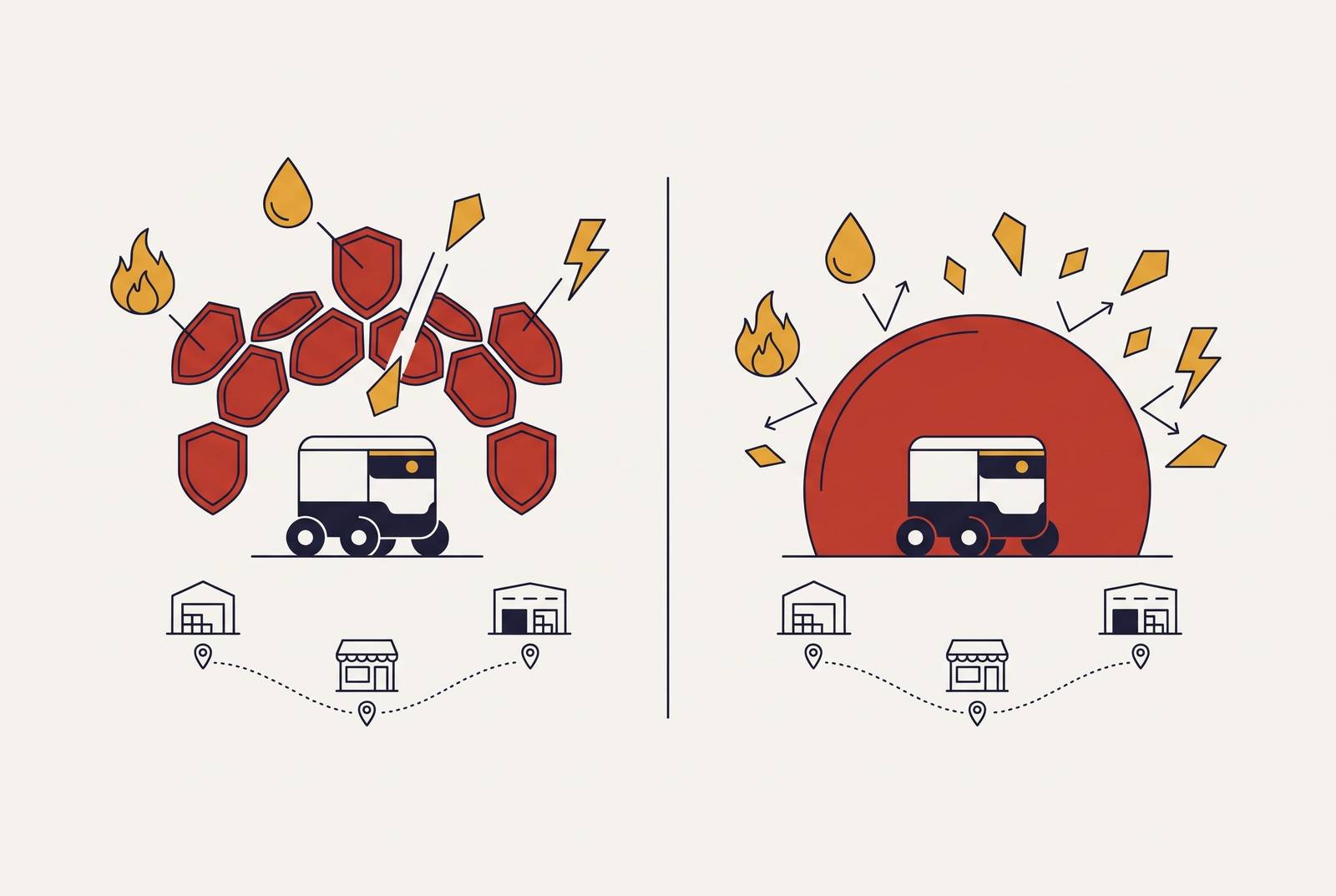
Open perils inland marine is the right coverage for deployed robot fleets that move between job sites, work at client locations, and are stored off-premises. Unlike named perils insurance, it covers causes of physical loss unless the policy specifically excludes them. For autonomous hardware, that breadth is functionally necessary because software-triggered damage, unexplained disappearance, and unfamiliar environmental losses may not fit a named peril. Its effectiveness still depends on the exclusions, deployment terms, and underwriting submission.
Why inland marine exists and what "open perils" actually means in that context
Standard commercial property insurance usually covers property at a fixed address listed in the policy. When equipment leaves that address, coverage typically lapses. Inland marine is designed to follow movable property in transit, at temporary sites, and in off-premises storage. For a robot traveling between deployments, the distinction is fundamental. The policy must follow the asset rather than depend on its remaining at one insured premises.
Within inland marine, named perils and open perils describe different coverage structures. Named perils covers specified events, while open perils, also called “all-risk” or “special form,” covers causes of loss except those expressly excluded. Who has to prove what? Under named perils, the policyholder must connect the damage to a listed event, whereas under open perils the insurer must establish that an exclusion applies to an otherwise covered loss.
A novel or unclear cause can defeat a named perils claim because the operator cannot establish the required connection. Under open perils, uncertainty alone does not identify an exclusion. The policy wording still governs.
How named perils policies are built, and what the standard list leaves out
These are recognizable events affecting goods, tools, and cargo. Their physical causes are generally distinct. The list fits conventional property that faces hazards from outside, but it is a poor fit for a working machine whose software can cause it to damage itself.
The list is the coverage grant. A genuine physical loss does not qualify merely because it resembles one of the listed events. Nor does a costly repair prove that the cause is covered. The claimant must trace the damage to the wording of an insured peril. If the evidence establishes an unlisted cause, or cannot establish a listed one, the form provides no general fallback for accidental damage.
Unexplained disappearance is not necessarily theft, and an environmental condition is not necessarily flood or windstorm. Software-induced mechanical damage also does not automatically fit an event on the list. The definitions control the outcome. Even a familiar word such as “collision” may describe an event involving a transporting vehicle rather than every impact involving the insured equipment.
Why robots deployed across multiple locations generate exactly the losses named perils is structured to deny
Each location has different floor layouts, ways that people interact with the robot, and environmental conditions, so the same robot faces different risks at each deployment. Losses may also occur without witnesses. With no person at the controls, the operator may have little cause-of-loss documentation when damage is discovered. Software versions and operating parameters can change during the policy term, further complicating the connection between the loss and a conventional peril.
Consider a robot that disappears from a remote deployment site without evidence of forced entry or witnessed theft. The equipment is gone, but theft remains unproved. A named perils form that covers theft but not mysterious disappearance therefore leaves the operator with an evidentiary gap. The missing fact is decisive. Under open perils, the analysis instead turns to whether disappearance is excluded or otherwise restricted by the policy.
A navigation update causes a robot to strike an obstacle repeatedly, damaging its chassis. If the named collision peril concerns the transporting vehicle, the robot’s own movement does not satisfy that definition. A LiDAR unit that degrades before a robot falls from a loading dock presents a related problem. The loss starts with sensor malfunction, which is outside the standard list of named events, so it has no clear match to an insured external hazard.
Condensation from an HVAC failure at a client’s warehouse corrodes a robot’s electronics, but the damage does not thereby become fire, flood, or vandalism. These examples share a structural problem. The operator can establish a damaged or missing asset without establishing a listed cause. Open perils removes that hurdle, but exclusions for deterioration, electronic failure, or other causes may still decide whether the insurer pays.
The AI exclusion wave now operating on top of the named perils gap
ISO introduced standardized generative AI exclusion endorsements CG 40 47 and CG 40 48 for commercial general liability policies effective January 2026. Its companion endorsement CG 35 08 applies to the Products/Completed Operations Liability Coverage Part and excludes bodily injury or property damage arising out of generative artificial intelligence. That scope needs careful distinction. The companion form targets generative AI in products and completed work, with autonomous systems or robotics within its scope only insofar as they involve generative AI.
ISO sets standards for a large share of the U.S. commercial insurance market, so these forms matter beyond the wording of any one insurer’s policy. Their availability establishes a standardized route for excluding generative AI losses from liability coverage. Adoption must still be assessed policy by policy. An operator cannot infer the presence or absence of an exclusion from the policy category alone, nor assume that every autonomous function falls within a generative AI exclusion.
A named perils equipment policy may fail because the physical cause is unlisted, while a liability policy may exclude a related liability claim because generative AI is involved. These are separate coverage questions. Neither policy cures the other’s limitation merely by being part of the same program. Open perils inland marine therefore needs its own review for AI, software, and electronic failure exclusions, without treating the ISO liability endorsements as inland marine forms.
What open perils inland marine actually covers that named perils does not, and where its own limits sit
Open perils covers physical losses from unlisted causes unless the policy specifically excludes them. Mysterious disappearance, software-caused mechanical damage, and unwitnessed sensor-failure incidents no longer require a match to an enumerated peril. That is the structural advantage. It does not guarantee payment for every such incident, because a relevant exclusion or coverage restriction can still remove the loss. “All-risk” describes a broad starting point.
Wear and tear and gradual deterioration remain important exclusions for robots. Expected component degradation differs from sudden damage caused by a software event, even when both leave the machine inoperable. Inherent vice creates another potential dispute. An insurer may argue that a design flaw predictably causing failure falls within that exclusion, making explicit treatment during underwriting important. Exclusions for war, government action, nuclear risks, and intentional acts by the insured also still apply.
Valuation is a separate decision from the covered causes. Scheduled coverage lists each robot with an agreed value, which reduces disputes over the insured value of that unit. Blanket coverage instead applies a total limit to the fleet. It simplifies administration for large fleets, but individual unit values may remain contested when a claim occurs. For high-value autonomous hardware, scheduled coverage is generally the more defensible structure.
Open perils also costs more than named perils. The higher premium reflects the broader exposure accepted by the insurer, rather than an administrative distinction between otherwise equivalent products. Price remains a legitimate placement consideration. For technically complex hardware operating across multiple sites, however, a cheaper form that omits the relevant loss mechanisms is not an equivalent alternative. The comparison must account for both the premium difference and what the operator would retain uninsured.
Why the underwriting submission determines whether open perils coverage actually works for autonomous hardware
The submission is where the broad coverage structure meets the actual machine. Standard inland marine applications were built for tools, cargo, and conventional equipment, so they may not ask for the facts an insurer needs to underwrite autonomous operation. Omissions invite assumptions about passive property. Those assumptions can affect the exclusions and limits long before the operator files a claim. Obtaining an open perils label is therefore insufficient if the insurer has not been given an accurate account of the asset.
Software version and update cadence describe a risk that may change after the policy is written. Sensor types, failure modes, and maintenance protocols help distinguish sudden accidental damage from expected degradation. Operating mode is equally significant. Autonomous operation, semi-autonomous operation, and remote human supervision affect how the insurer understands an impact or unexplained disappearance.
The number of sites, their types, and their access controls explain where the fleet operates and the accumulation exposure the insurer must price. A generic equipment description cannot supply that context. Carriers increasingly use external data to validate submission details and examine them again at claim time. A mismatch between the submitted description and actual operations can narrow or void coverage when the operator needs it.
Operators should present those characteristics explicitly and address exclusions during underwriting, before claim interpretation. A specialist submission gives the carrier a basis for accepting autonomous hardware as such. It also makes unresolved assumptions visible before binding. Two policies can both say “open perils” while differing materially in exclusions, available limits, and claims handling because only one was placed around the actual operating risk.
How do operators insure a fleet of mobile robots operating across multiple locations?
Operators should ask carriers specific questions about the losses and deployment changes the fleet can produce. Does the form respond to software-triggered physical damage, or does a software or electronic failure exclusion remove it? Does the policy cover mysterious disappearance, and is there a sublimit? Operators should also check the definitions before the policy binds. Does “collision” include a robot striking an object under its own navigation, or only damage sustained during vehicle transport?
Does coverage extend to every scheduled deployment site, or only the locations listed at inception? Does a software update that changes the operating envelope require an endorsement as a material change? The AI wording needs a separate answer. Is there an AI exclusion in the inland marine policy, and precisely which operations or causes of loss does it foreclose?
Operators should ask the insurer to confirm that the open perils form covers autonomous, AI-directed physical operations. That confirmation establishes the intended equipment coverage, but it does not remove an exclusion from a companion liability policy. Blanket location coverage is another useful provision. It adds newly deployed sites automatically rather than requiring an endorsement for every new client location. For high-cost scheduled robots, agreed value also addresses disputes over depreciated versus replacement value at claim time.
Placement should go to carriers that explicitly underwrite autonomous hardware, with a specialist broker reviewing the full policy before it binds. Fit requires their forms and claims processes to address autonomous failure modes rather than rely on adaptations of conventional equipment wording. The quote sheet alone cannot establish that fit. Broker commissions are built into placement regardless of who places the policy, so choosing a generalist over a specialist is not a premium saving on that basis.
The contract must therefore determine the final placement decision. Open perils supplies the necessary starting structure, while negotiated exclusions, deployment provisions, valuation terms, and an accurate submission determine its practical reach. A specialist broker’s pre-binding review is the safeguard against discovering those limitations only after a robot is damaged or disappears.